Reviews and thoughts about movies, books, pop culture, and Doctor Who
Author: Peter Kanelis
I was born in Portland, Oregon and currently reside in Texas. I am an avid reader and movie watcher. I also am a long-time Doctor Who fan and collect the audio dramas as well as watch the television series. I have been writing reviews of this nature on social media for a few years now and want to expand on that practice.
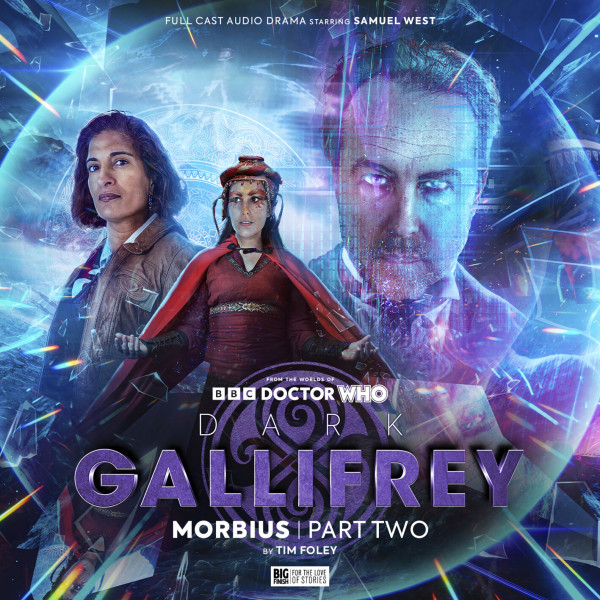
Big Finish Productions has started what appears to be a promising spin-off series from the Doctor Who range of audio dramas with Dark Gallifrey: Morbius Part One starring Samuel West as the ancient tyrannical Time Lord known as Morbius.
Tim Foley is the writer with Samuel Clemens serving as director. The talented cast includes Mina Anwar, Rachel Atkins, Justin Avoth, and Janet Narrata. Hywel Morgan, Andrew French, and Lara Lemon round out the cast.
This episode has the feel of a cosmic sea adventure. The Time Lord battleship Proteus is returning to Gallifrey after achieving a major victory in their war against the renegade Morbius. The captain has recently regenerated but still may not be fully recovered. There is a mysterious force lurking in the shadows below deck.
Foley relies on a pretty standard trope of what sort of sounds like a pirate adventure, but he does it well. The crew of the Proteus are not pirates, but the characterizations seem somewhat similar to those type of stories. The performances are solid, which is almost always the case with Big Finish releases.’
It’s sometimes not an easy story to follow, but this is only the first one in a trilogy.
Samuel West has been playing Morbius periodically for Big Finish in recent years, and there is no reason to find another substitute. Morbius was in only one television story during the Tom Baker era, but he has made a lasting impression on the fan base. He was originally portrayed by Michael Spice in The Brain of Morbius.
This is a pretty good start for a series that really doesn’t feature the Doctor, and I am intrigued enough to continue my journey through Dark Gallifrey.
Doctor Who: The War Doctor Begins: He Who Fights with Monsters continues the saga of the War Doctor, originally portrayed by John Hurt, and leads to a fascinating confrontation with a mysterious adversary known as the Barber-Surgeon. The set has three parts and was written by Robert Valentine and directed by Louise Jameson.
Since Hurt has been deceased for a little while now, Jonathon Carley has taken on the role which has been known in Doctor Who fandom as the War Doctor. This was a once unknown incarnation of the Doctor who had rejected his name since he had to fight in the Time War and use methods that his other selves would abhor. Carley does an increasingly amazing impression of John Hurt’s distinctive voice and puts forth a powerful performance.
The first part is entitled The Mission where the Time War Council enlists the War Doctor to hunt down and assassinate another Gallifreyan renegade known as the Barber-Surgeon. The Barber-Surgeon has been a thorn in the side of both the Time Lords and the Daleks. The War Doctor doesn’t like the nature of this mission, but this incarnation is the one most capable to complete it
The Abyss has the War Doctor on the Barber-Surgeon’s trail through the devastation of the Time War and his own past. The Daleks have also sent a Dalek Hunter-Killer played by Jason Merrells. The War Doctor and the Daleks have another confrontation in which the maniacal robotic conquerors may finally exterminate their most persistent enemy.
Finally, the War Doctor has to escape the Daleks and confront The Horror. Nicholas Le Prevost plays the rogue element in the Time War known as the Barber-Surgeon. He and Carley play beautifully off each other when the Doctor and the Barber-Surgeon finally meet.
Not that much known is known about the War Doctor other than he was the one who ended the Tine War by obliterating both sides. He was rejected by his subsequent incarnations following that event.
This set reveals how the War Doctor may have been influenced into that horrific, if necessary, decision.
It took me a bit to warm up to the first two episodes, but Carley’s performance kept me engaged, and the finale to this set was worth it.
This is probably one of the best sets in this range. Carley may be able to sound a lot like John Hurt, but he also demonstrates excellent instincts as an actor. He mastered how this version of the Doctor carries such determination and weariness in his voice.
The sound effects are excellently executed. There are times when the action sequences seem a little jumbled, and it was hard to picture what was happening in the imagination. Still, the performances of Carley and the guest cast more than make up for it. Louise Jameson even reprises her role of Leela, which was not unexpected but still pretty fun.
Anyway, I think I have resolved any misgivings I had about the creation of the War Doctor. This set is just great.
The Case of the Whitechapel Vampire is a 2002 Sherlock Holmes film that is mediocre at best. Rodney Gibbons is the writer and director of this thing which originally aired on the Hallmark Channel of all places. Matt Frewer is cast as Sherlock Holmes alongside Kenneth Welsh as Dr. John Watson.’
Kathleen McAuliffe, Michel Perron, Joel Miller, Danny Blanco, and Norris Domingue are included in the cast.
It has been two years since the infamous Jack the Ripper terrorized Whitechapel district, and another round of strange murders have occurred in that same area. Sherlock Holmes and Dr. Watson are called in by an order of monks who believe that a vampire is stalking the streets. Holmes is adamant that there is nothing supernatural behind the killings in spite of appearances. Holmes is once again challenged to provide a rational explanation for something that seems to bizarre and otherworldly. He also has his agnosticism challenged as Watson begins to consider that a vampire is actually the culprit. Even if the vampire is real, he may still find Sherlock Holmes to be a very formidable foe.
There are some intriguing elements in this story. It has some potential, but it just seems a little trite and overdone. Some of these pastiche writers really focus a lot on Holmes facing something potentially supernatural when Arthur Conan Doyle just did not have that many stories like that.
Matt Frewer was a reasonable casting choice for the lead role, but he could have employed a little more subtlety in his performance. I did rather like Kenneth Welsh’s portrayal of Dr. Watson.
Not everything in this film was a failure. I just didn’t find Frewer’s portrayal of Holmes all that interesting. It just felt like it was by the numbers. Frewer physically looks quite a bit like how Doyle described Holmes in the original canon, so that did help.
There was also once again, as I have mentioned before in some of my previous critiques of Holmes pastiche stories, an element of the Scooby-Doo reveal toward the end.
I figure the reason that I had not seen this one before is because it was on the Hallmark Channel, which isn’t known for hard-hitting originality in their films.
It was not a terrible viewing experience, but it sure was not anything one should go out of their way for.
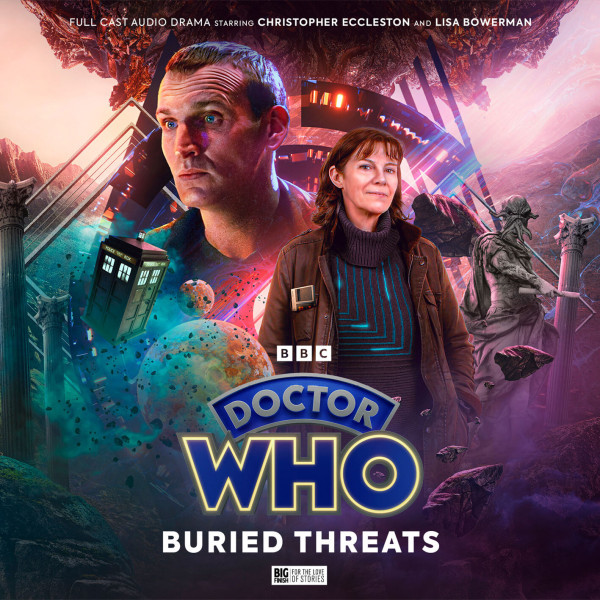
Buried Threats is one of the audio releases from Big Finish Productions that continues the Doctor Who range featuring the Ninth Doctor, played by the brilliant Christopher Eccleston. There are three episodes directed by Helen Goldwyn. Lisa Bowerman returns to the mic as Professor Bernice Summerfield, which is indeed welcome. The set is pretty good, but not much really stands out.
The first story by Lisa McMullen is entitled A Theatre of Cruelty. Alexander Vlahos takes on the role revolutionary artist and theatre director Antonin Artaud. Artaud is having dreams that are breaking into reality, and the Doctor suspects an alien influence as usual. The episode did introduce to me a new historical figure of which I was unaware. It had an interesting plot, but Eccleston has usual really elevates the story with his energetic performance as the Doctor. I enjoyed the episode, but I doubt I will remember much about it until I replay it.
The Running Men is the second entry written by Mark Wright and takes place in present-day Halifax in West Yorkshire. Fiona Wade is the main guest star alongside Eccleston. In this one, I learned about an infamous gibbet and an old legend about the spectral Running Men. In case anyone wants to know, a gibbet is like a gallows where people were executed long ago. A mysterious death brings the Doctor to the scene where historical tragedies are intruding on the present.
It’s also a good story where an uncommon legend is revealed to me. That helps me find some enjoyment and appreciation. It highlights a small piece of British culture and a town which apparently has some renown.
The performances are quite compelling here as is almost always case in a Big Finish release. Yet again, it’s an episode even with its interesting elements still doesn’t stand out as anything quite that unique.
Finally, Professor Bernice Summerfield encounters a new Doctor to her in Matt Fitton’s Ancient History. Benny is looking into a long-ago disappearance of a warrior race known as the Korravin. When she sees a battered blue police box, she knows an old friend is nearby and another danger is about to be unearthed.
This time, the Doctor has initially slipped in incognito with an alias. Benny doesn’t recognize him at first due to the Time Lord’s propensity for regeneration. When she does figure it out, she is not too pleased, but they get past that soon enough and work together like the old days.
This one is probably the stand-out of the set because of Bernice’s presence. Lisa Bowerman slips into the role with such ease, and the chemistry with Eccleston is quite evident. I think Benny actually pairs up well with any of the Doctor’s iterations. The moment of recognition is as deliciously volatile and funny as I hoped. There is even a little time for Fitton to tug the heartstrings a bit as Benny tries to figure out what the Doctor has been up to since they last met.
Overall, the set is enjoyable but is only really notable in that Bernice and the Ninth Doctor meet. The three writers are well-chosen for their reliability. Some of the more obscure elements of British history given a spotlight is pretty cool. Eccleston still has the chops to keep his Doctor compelling in all of his manic and often morose behaviors. This Doctor has survived the Time War and the terrible choices he had to make and live with.
This set of audio dramas may not be listed as one of the iconic releases by Big Finish, but it is once again not one that deserves to be ignored, and I am certainly up to more Ninth Doctor exploits.
Thunderbolts* is the latest cinematic offering from Marvel Studios and actually manages to be a piece of solid entertainment. Eric Pearson and Joanna Calo wrote this engaging script, and Jake Schreier claims the director’s seat and may have breathed a little more life into the superhero film genre. Florence Pugh reprises her role of former Black Widow assassin, Yelena Belova. Sebastian Stan returns as Bucky Barnes, the Winter Soldier, who is now a United States congressman. Of course, that doesn’t mean that Bucky has lost any of his punch. Wyatt Russell, Olga Kurylenko, Lewis Pullman, Hannah John-Kamen, Julia Louis-Dreyfus, and David Harbour are also included in the cast.
Valentina Allegra de Fontaine, played by Louis-Dreyfus, is now the CIA director and has been involved in some controversial black ops which has led to her facing an impeachment. She sets up some of her super-powered operatives to kill each other in a remote lab that also needs to be sanitized to protect her secrets. Yelena, John Walker, Ghost, and an enigma named Bob end up escaping the trap, but Bob is abducted by de Fontaine’s agents where whatever experiments were being conducted on him may continue. The ragtag group of contract killers have only each other to rely on until they are joined by the Winter Soldier, and Yelena’s crazy father figure who is a Russian super soldier known as the Red Guardian. Bob has transformed into a being with frightening abilities and a dark past that fuels the Void within him. This new team of loners and renegades need to figure out how to combine their abilities and save the world without the Avengers to back them up.
Pugh is actually quite fun to watch, and I think the Russian accent she affects is pretty good. I am not so sure about Harbour’s, but he did fine as well with his manic energy as Alexei Shostakov. He was pretty fun to watch, although I also appreciated the chance to catch my breath when he wasn’t onscreen. The cast was pretty well-chosen. Julia Louis-Dreyfus did quite well as a smug elitist with too much power and not much caution in achieving her goals.
The special effects were typically well executed. The fight scenes were also quite compelling if as typically implausible as expected in a comic book movie.
The story does get into some themes of despair and the effects of trauma, but there is enough humor peppered throughout to help not get too depressed. Some of the one-liners even landed pretty well,
I don’t think the film is as good as the early Marvel films such as Iron Man and the first Avengers installment, but it sure wasn’t as dubious as some of the more recent offerings in this franchise.
Pugh is still relatively new in the limelight, but she does have plenty of talent and charisma. The scenes she shares with Harbour were often hilarious, but there was one pretty moving moment between their characters.
The film was just good, and I am looking forward to getting together with this cast of misfits again.
M is a German thriller film, that is beautifully shot but slow-paced, released in 1931 and is directed by Fritz Lang. Lang also co-wrote the film alongside his wife, Thea von Harbou.
Peter Lorre is in the lead as a serial murderer of children named Hans Beckert. Other cast members include Otto Wernicke, Inge Landgut, Gustaf Grundgens, and Theo Lingen.
Berlin is being terrorized by a killer who abducts children. While the police are diligently trying to track the elusive Hans Beckert down, the local mafia group is also concerned about the buzz of activity from law enforcement that is interfering with their dubious dealings. Beckert will face justice, but it will either come from the courts of Berlin or those who reside among the streets he has stalked.
As mentioned before, the cinematography for that time was quite good. Lorre’s talent is pretty evident in this very early performance in his career.
The film also delves into the early days of forensics and handwriting analysis. This film is one of the first of what is known as police procedurals.
Lang is one of those legendary early film directors, and this piece showcases the reason why he has so much acclaim.
The film does feel a little long even though it does come in just under two hours. There are moments that it seems to drag. Ultimately it does deal with the questions surrounding justice and vengeance. It also raises the question of what the punishment should be if someone could truly be insane.
The dialogue is in German, so for us Americans, the subtitles are an essential friend.
The film does have some historical cinematic significance, but it does take some patience and probably more of an early day viewing.
Sinners is a new horror film written and directed by Ryan Coogler, and it holds up rather well considering the genre. Coogler has gained some deserved acclaim for Black Panther and the Creed films. This film isn’t going to be the one to knock him off his perch.
Michael B. Jordan has a dual role playing twin brothers known as Smoke and Stack. Okay, the nicknames are a little over the top, but I do still think being called Smoke at least would be kind of cool. Hailee Steinfeld, Jack O’Connell, Wunmu Mosaku, Delroy Lindo, and Miles Caton are included in the cast and are solid choices.
Smoke and Stack leave the urban troubles of gangster-ridden Chicago and return to the Mississippi Delta with a lot of cash and ambitions to open a juke joint in 1932. Past romances seem to be rekindled. Old friends unite to pull off this little party, and troubles involving the Ku Klux Klan aren’t going to be a major headache. Of course, Smoke and Stack are former soldiers and gangsters, so they are not so easily perturbed by racists and killers. When the vampires crash the party, that’s a little different matter.
First of all, the setting is great. Jordan is easily a compelling presence, and he does well with playing both brothers. The cast altogether is quite effective. The brothers have a cousin they recruit for the musical talent. Miles Caton is a great find with his smooth baritone. This seems to be the early days of the blues, and the soundtrack is pretty captivating. The idea in the film is that blues music can have mystical powers when played by the right musician. I can almost buy it after this film.
O’Connell plays the lead vampire, who happens to be Irish, and that culture seems to get kind of a nod as well.
The story takes its time getting going, but once the bad guys are revealed, it gets interesting and would be terrifying if I was a bit more of a nervous disposition.
There are some interesting twists toward the end. There are plenty of vampire flicks, but Coogler seems to found a vein of something original.
This film did ensure that I will be keeping an eye out for Coogler’s next project.
The Trials of a Time Lord is a recent Doctor Who audio drama released by Big Finish Productions and is another effort to celebrate forty years of the Sixth Doctor, portrayed by Colin Baker. It is a six-part saga with writing credits shared by three writers. Bonnie Langford and Nicola Bryant, who play Mel and Peri, respectively, join the Doctor against his battle against a plethora of old adversaries.
The writers, who ended up splitting up the story with two episodes each, are Katharine Armitage, Stewart Pringle, and Rochana Patel, and I have little objection to this slate. Jonathan S Powell directs this saga. The story does hold up pretty well in spite of a premise that sounds on its face, to be somewhat chaotic.
David Banks returns to voice the Cyber-Leader alongside Nicholas Briggs as the rest of the Cybermen. Terry Molloy reprises his role of Davros, the twisted creator of the Daleks. John Culshaw is also a part of the cast and does a passable impression of the late Anthony Ainley as his iteration of the renegade Time Lords known as the Master. Other cast members include Aruhan Galieva, Holly Jackson Waters, Samuel Jones, Rufus Jones, and George Naylor.
The Doctor and Mel arrive in a prison camp known as Cyberia in response to a distress signal and find themselves about to embark on a televised series of challenges which reveals all manners of menaces and allies.
Some themes are revisited such as the idea that the Doctor is being televised as he faces all sorts of threats and obstacles. This was already explored in the television story Vengeance on Varos, however I don’t mind the repetition here. There is enough of a creative effort to have this one come off as a bit more special.
Fans finally have Mel and Peri meet and interact, which was kind of cool to hear. Peri returns after living a life as a warrior king alongside King Yrcanos, who fans met in the original serial, The Trial of a Time Lord. Peri comes with some seasoning as a mother and a fighter. Normally, I would find such a character transformation somewhat implausible, but Bryant sells the performance well enough.
Jon Culshaw filling in for the late Anthony Ainley was kind of a surprise and may count as a spoiler, which I normally try to avoid. He does well enough, but he may need to practice that impression a bit more. It was still fun to imagine that version of the Master cropping up again, and Culshaw doesn’t really miss the mark entirely. It just wasn’t a bullseye impersonation. I will say this about Culshaw himself. I really enjoy his insights and comments during the cast interviews. He knows Doctor Who lore, probably better than most of the actors who portrayed the Doctor. He has such an infectious enthusiasm for the show and just seems like a joy to the rest of the Big Finish cast and crew.
Colin Baker still sounds energetic and credible in his role. The characterization of the Sixth Doctor has been improved greatly under the care of Big Finish writers over the past couple of decades. It was a sweet moment when he realizes that his friend, Peri, has really been reunited with him.
This is a story that feels a little chaotic and self-indulgent at times. I am somewhat leery of stories that just unleash all of the past enemies and story ideas, however this particular release handles this direction better than most. I also tend to sneer at three writers on one story, however the construction here kind of makes sense. The writers did work well together, but they worked on two episodes apiece separately. This division of creative labor would likely only work in a saga like this.
It’s an enjoyable and proper celebration of Colin Baker’s era, and I am glad that we are likely to get more adventures from Big Finish for some time to come.
Never Lie by Freida McFadden is an outlandish and improbable thriller that is a pretty entertaining ride for those willing to suspend their disbelief.
A newly married couple are in the market for a new house and arrive during a blizzard to an isolated manor that was once owned by a prominent psychiatrist who has been missing for a few years. Tricia and Ethan are trapped at the manor, which is curiously still completely furnished. Tricia finds a secret room containing a cache of cassette tapes that have the sessions with Dr. Adrienne Hale recorded. Tricia has an opportunity to see if the solution of the doctor’s disappearance is contained within these recordings. More old secrets and lies are about to be exposed, and Tricia learns that not everything is going to stay as buried as deeply as she hoped.
McFadden has become one of today’s most popular thriller writers, and she does have quite an imagination. However, she does rely pretty heavily on some very common tropes of the genre. Also, there is quite a lot of implausible coincidence that can be a little exasperating. Sometimes, the characters are not that believable. As mentioned before, the suspension of disbelief can feel a little taxing.
Still, I did enjoy the novel. There are some clever twists that kind of surprised even me. McFadden is not really an extraordinary writer, but she gets the job done. She might just be the ultimate popcorn writer of today. If it pays the bills, who am I to complain?
McFadden may be a bit overrated, but she at least avoids being just flat out bad, which is an impressive achievement in today’s literary climate.
This is only the second novel I have read by her, but I work in a bookstore these days, so I am aware of her popularity. I do like that she writes a lot of standalone novels, so I can dip in and out of her works without worrying too much about continuity. There are actually a lot of series that I don’t read in order, but I do recognize that it an advantage that McFadden has with her bibliography.
McFadden is at least fun to read, and I am certain that it will not be all that long before I am perusing her section on the bookshelves.
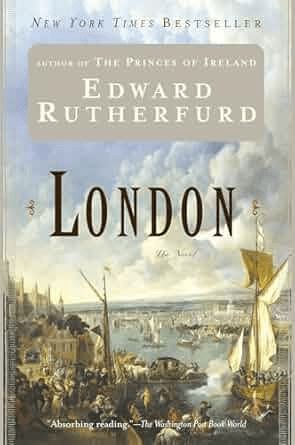
My next read has been in the queue for a while. I have been putting it off because it seems to be a daunting volume by Edward Rutherford. I am looking forward to trying it because it isn’t my usual genre of enjoyment, and I like to test my mettle a bit when it comes to my reading choices. It is also about one of bucket list destinations for travel. It is well past time that I learn the intricacies of London as only Edward Rutherford can tell it.