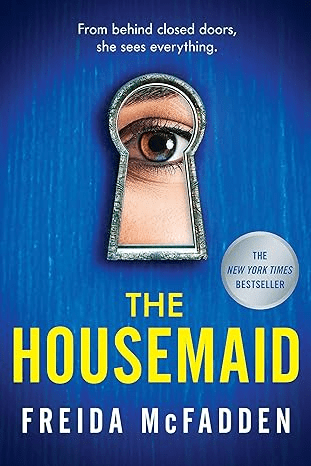
The Housemaid is a pretty average adaptation of a bestselling novel by Freida McFadden, directed by Paul Feig. Rebecca Sonnenshine is the screenwriter who came up with the script that was helped by a pretty talented cast.
Sydney Sweeney stars as the seemingly hapless maid, Millie Calloway. Amanda Seyfried, Brandon Sklenar, Elizabeth Perkins, and Michele Marrone are also included in the cast.
I had just read the novel a few days ago, so my impressions of the film are probably somewhat influenced. Spoiler alert…the book is better.
Millie Calloway is recently paroled after serving a decade in prison for manslaughter. She has unbelievable luck when she lands a job as a live-in maid at the Winchester household. The luck seems to be a false flag when Mrs. Winchester seems to be quite mentally unstable. Millie seems to have an ally in the husband, but that gets complicated as well. Not only that, Mr. Winchester has his own agenda. Of course, neither knows that Millie is not exactly as mild-mannered as she appears either.
The film is mostly faithful to the source material. It does gloss over some important background information a bit more than necessary. This is another film where I question the editing. Also, certain details were altered a bit that I thought was unnecessary.
I will acknowledge that the cast was well-chosen. Sweeney is a very beautiful woman who also happens to have some talent and charisma. Seyfried does quite well as the seemingly erratic housewife. The two women work well together in their antagonistic roles.
Anyway, the talent of the cast does make it a watchable film, but it still falls short of great cinematic ingenuity.
I guess it’s just the risk I take when I read the novel just a day or so before seeing the movie. At least, it was not a terrible film.
Doctor Who: The Eleventh Doctor Chronicles Volume 5: Everywhere and Anywhere is a recent audio boxset from Big Finish Productions with Jacob Dudman reprising his role of the Eleventh Doctor with his uncanny impression of Matt Smith. Safiyya Ingar continues in her role as cyborg companion Valerie Lockwood.
In this set, Nicholas Briggs is back behind the mic as the voice of the Cybermen.
Other guest cast members include Maddison Bulleyment, Sean Connelly, Edward Harrison, Jack Myers, and Brad Shaw.
This collection was directed by Helen Goldwyn, which is often a good choice.
There are three stories featuring the Eleventh Doctor and Valerie Lockwood, and they are pretty solid.
The first story is basically a Christmas story, done Doctor Who style written by Georgia Cook. Spirit of the Season concerns a child who says her name is Clara, and she wants to kill the Doctor and Valerie. They are trapped in a strange house with other people, including Valerie’s strangely resurrected mother, played by Mandi Symonds.
It’s a pretty good start to this collection. Becky Wright plays the malevolent alien claiming the name Clara and is appropriately wicked.
All’s Fair, written by Max Kashevsky, has Valerie on a first date in Chicago during the World’s Fair 1893. A man turns up claiming to be Valerie’s husband, and the TARDIS team find out how merciless Time can be. Valerie is destined to die in this time period, but she has to defeat the monsters stalking the streets of Chicago and ruining her date.
It was an interesting story and well performed. I am not all that familiar with this particular writer, but I thought he presented a decent script. Some of the action scenes were hard to interpret by audio, but that’s not unusual for this medium.
Sins of the Flesh, written by Alfie Shaw, brings this collection to a close. In a society that is trying to eradicate sinful behaviors, they have turned to something called Redemption Suits. The Doctor recognizes this as taking a step into conversion into a Cyberman. He and Valerie are trying to prevent a colony for paying a terrible price in their efforts to remove temptations of the flesh.
I tend to enjoy a good Cyberman story, and this one qualifies. It gets a little preachy though, which is distracting at times, but Shaw still sparks the imagination when he depicts of the horror of cyber-conversion. Briggs hasn’t lost his touch in bringing voice to one of the more iconic Doctor Who adversaries.
Dudman continues to shine in his impression of Matt Smith’s interpretation of the meandering Time Lord. Valerie is a somewhat intriguing companion, and Ingar does well on some of the more emotional moments in this story and the previous ones in this collection.
This is a pretty solid trilogy for the most part. Valerie is a creation of Big Finish and as usual an intriguing addition to the crew. Dudman is a gifted impressionist and does well in representing the Eleventh Doctor era.
It’s an enjoyable release but not really a remarkable one. It’s good enough for me to continue collecting in this range though.
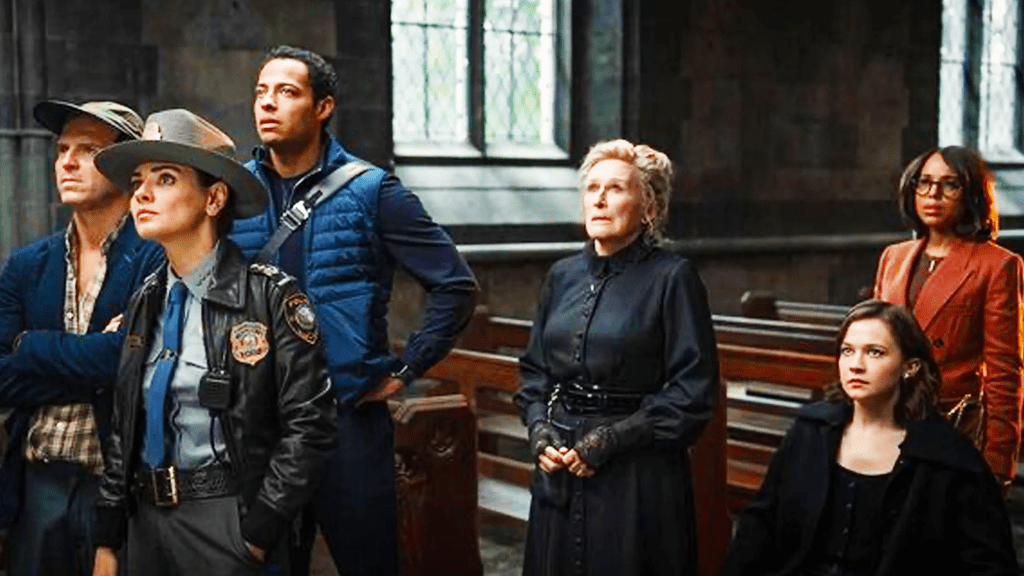
Wake Up Dead Man: A Knives Out Mystery is the unimpressive third film in the franchise that stars Daniel Craig as private detective Benoit Blanc. Rian Johnson wrote and directed this somewhat lackluster sequel. Daniel Craig returns as the enigmatic Benoit Blanc.
More big Hollywood names are in this case. Josh Brolin is the one who gets knifed in the back as Monsignor Jefferson Wicks, a rather fiery and ferocious church leader with a not so holy agenda. Josh O’ Conner, Glenn Close, Mila Kunis, Jeremy Renner, Kerry Washington, Adam Scott, and Jeffrey Wright are also included in the cast. So, there is a lot of talented and prominent names here whose talents are just wasted.
Benoit Blanc is asked to help out in investigating the murder of a monsignor who was stabbed in a storage near the pulpit of a church while services were being done. Blanc finds a peculiar group of suspects and is assisted by a young priest who was once a boxer. Suspicion falls on the young priest, and Blanc is not so sure he will be able to solve the case.
First of all, Johnson lets his political preferences shine throughout here in the writing of his script. He just couldn’t stay neutral on matters of religion or much else. That’s to be expected with most of the sludge coming out of Hollywood these days.
The story was not that interesting, and the film ran too long for the genre. Only a few of the cast members had interesting roles. Benoit Blanc had nothing new to show his audience. Daniel Craig was fine in the role, I suppose, but he was not as compelling as usual.
Adam Scott, who is best known as Jim Moriarty in Sherlock, was sort of fun to watch. A few other cast members had enough talent to sometimes be interesting.
Overall, the mystery itself was not that interesting. I didn’t really care about the murder of this monsignor. The film was obviously just a venting session against religion or any conservative viewpoint, which is to be expected these days from Hollywood, but Johnson just failed when it came to clever subtlety in the writing.
The movie still isn’t what I call terrible because the cast is just good enough to keep it within the range of mediocre. There was enough to represent basically my genre where I can’t say that I absolutely hate this film, but there were facets that were just annoying and unnecessary.
I will acknowledge there was some redeeming qualities toward the end. Johnson didn’t quite veer off into some overly heretical road, but he did enough limit my enjoyment of what could have been a compelling murder mystery.
Unfortunately, aspects of my personality will likely compel me to keep an eye out to see if another installment is forthcoming, and I do find the lead character Benoit Blanc to still be somewhat interesting. Better luck next time, guys!
The Housemaid is the thriller that seems to have put Freida McFadden on the chart of literary prominence currently, and it’s actually pretty good.
Wilhelmina Calloway, who thankfully goes by Millie, is desperate for a job after a long stint in prison, and a position as a live-in maid with the Winchester family seems to be her ticket to a better situation. Nina Winchester appears to be at least a reasonable boss until she starts exhibiting signs that suggest that she is flat-out crazy. Millie’s options are limited, so she tries to make an increasingly puzzling and alarming situation somewhat bearable. What Nina and her seemingly dreamy husband do not know is that Millie does have a breaking point, and she may be more dangerous than they could ever imagine..
McFadden does know how to ratchet up the suspense and keep a reader engaged. Her prose is actually quite engaging, and it’s fun to see what twists she has coming.
Sometimes, the revelations rely a bit more on coincidence than I would like. I will try to avoid any real spoilers in this blog for the seeming few that have yet to read the novel. Also, it felt that the reader has to wait quite a while for some new nugget of useful information as to why some of these behaviors are occurring.
McFadden switches first person perspectives in this one, which actually works here. Fortunately, she does it by sections so one is not constantly having to adjust mentally to these shifts.
There are times when the story seems to drag a little, but I enjoyed the experience overall. I have read other McFadden novels before and have yet to be truly disappointed. Sometimes, the resolutions to her plots stretch my credulity a little more than I would like in this genre, but it’s not too distracting. In fact, I find these moments more amusing than maddening, so I guess McFadden can stay in the game as far as I am concerned.
Anyway, I have been aware of the popularity of this book for some time, and I did find it enjoyable enough to likely do add more McFadden novels to my shelves.
Well, as customary to this blog, I will give a brief glimpse at the next reading indulgence. Doctor Who novels are still being produced, so I thought it would be time to return to the doors of the TARDIS with a new one featuring the First Doctor. Paul Magrs has returned to the franchise with his contribution, Doctor Who: Dracula!
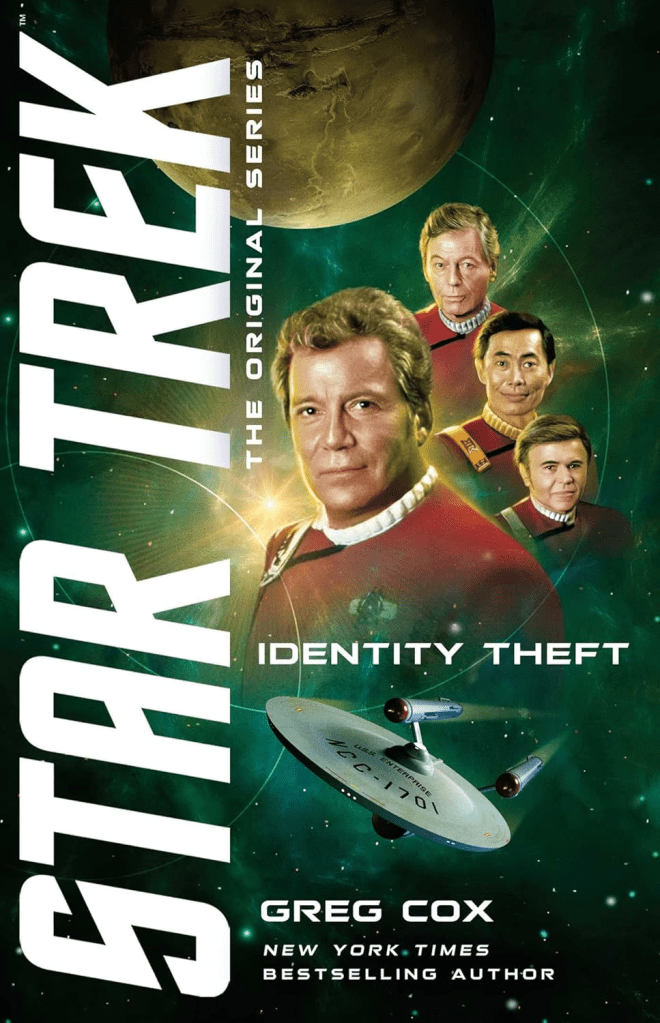
Identity Theft is a recent Star Trek novel by Greg Cox that kind of tested my patience at the beginning and got better as my voyage through the pages progressed.
The crew of the Enterprise is sent to the planet Voyzr twenty years after they had helped the denizens end a civil war to attend a celebration of the peace agreement that has lasted. The problem is that a group of exiles have hatched a plot to assassinate the current leader of Voyzr since not everyone felt they received fair treatment. This group has gotten hold of a mind transference device and are able to abduct one Commander Pavel Chekov to have him replaced with a disgruntled and determined imposter. Chekov, now in the body of an alien, must escape his captors, catch up to the Enterprise, which has been sidetracked by another rescue mission, and stop an insidious plot to reignite a war.
I experienced a moment of exasperation when I realized that this was a mind-swap story, which is a pretty common plot in science fiction or fantasy. The novels tend to spend a little too much with somewhat nostalgic plots. Of course, the television episode, Turnabout Intruder, was heavily referenced.
As the story unfolded, I found myself more compelled by the idea of Chekov being the focus of the story. This takes place sometime just before The Undiscovered Country. The crew have already experienced the death and subsequent rebirth of Spock, the voyage to the twentieth century to find whales in order to save Earth and facing down a being who was impersonating God.
This novel focused on an older Chekov, who was able to use his Starfleet experience and the examples left by Captain Kirk to overcome the various obstacles to reclaim his body and foil the assassination plot.
Cox has written several Star Trek novels and is usually quite reliable. I should have had a bit more faith in his ability to make this somewhat overdone science fiction trope into something a bit more compelling.
He also delves into the mind of the would-be assassin named Ryjo, who finds himself experiencing the special comradery Chekov has experienced serving with his friends for a couple of decades. Ryjo ends up being instrumental in saving the lives of several of his crewmates when their unexpected rescue mission goes seriously awry.
This novel turned into a nice surprise in that I enjoyed more than I expected when I first started out. I always have fun revisiting the Enterprise under the command of James T. Kirk, and Cox helped make sure that I will return when the next installment hits the shelves.
Next up, I am going to see what all the hype is about concerning Freida McFadden’s The Housemaid.
Doctor Who: Time War Uncharted 1: Reflections is a recent Doctor Who audio boxset from Big Finish Productions and takes the Eighth Doctor, played by Paul McGann, into some intriguing depths of the Time War in four episodes. Emma Campbell-Jones and Sonny McGann reprise their roles of Cass Fermazzi and Alex Campbell, respectively. Alex is the Doctor’s great-grandson who was resurrected by the peculiarities of the Time War that has thrown the universe into an upheaval. Cass has been lost between dimensions and struggles to find her way back to her friends, who may nor remember her.
Some familiar faces or voices are part of the guest cast. Familiar to Big Finish listeners anyway. The guest cast is comprised of Dempsey Bovell, Helen Goodwyn, Holly Jackson Walters, Amara Karan, Nicholas Khan, Hattie Morahan, Jon-Paul Rowden, Dan Starkey, and Conrad Westmaas.
The first of the four episodes contained in this collection is Nowhere, Never by Katharine Armitage. Cass finds herself living as a housewife in a place where air raids are being conducted on her community. The Doctor and Alex are trapped in a peculiar hospital ruled by an even more peculiar Matron. No one seems to remember much about their pasts, but the Doctor will soon start to understand how fractured the universe has become.
This is a bit of a confusing mess to be done on audio, but the performances more than make up for it. It’s also setting the stage for the Doctor’s participation in the Time War. The character of Cass is starting to grow on me, and the banter that has developed between her and Alex is quite well written. Paul McGann’s performance continues to flourish as well.
Although I called this particular story a confusing mess, I still enjoyed it. The nature of the underlying story concerning a Time War is just going to cause all kinds of mental gymnastics in understanding the sequence of events.
Tim Foley follows up with The Road Untravelled in which the Doctor, Alex, and Cass find themselves aboard a strange spaceship. The Captain of the vessel is an old, unreliable adversary, who is played by Conrad Westmaas. They are trapped in the Void, however another presence has followed them, and the Time War rages even there.
The second story by Foley is pretty good as well. It’s one of those awkward episodes which continues the set-up to the big reveal that is going to occur in a future episode. Westmaas was better known in the franchise as C’rizz, a companion of McGann’s Doctor many years before. He does get to stretch a bit more in this role as Hiernonyma Friend.
Foley is a reliable writer and will hopefully be commissioned many more times. He also gets to wrap up this set, but I will get to that in a couple of paragraphs.
James Moran delivers what I think is the most compelling episode in the set entitled Cass-Cade. Cass is trapped in a space station is falling into a sun, and she keeps encountering the Doctor and Alex in different moments of the adventure out of sequence. Unfortunately, they don’t remember her beyond some vague sense of familiarity. Anyway, this sounds more confusing and muddled than the first episode, but it actually holds up and makes a little more sense. Campbell-Jones gets a plethora of one-liners throughout, and she delivers them sublimely.
Anyway, I enjoyed that one the most, but the set is pretty good overall.’
Finally, Tim Foley gets to return with Borrow or Rob which has the Doctor and his companions losing their grip on reality, leading to a shocking betrayal.
I like this particular TARDIS team. The Eighth Doctor’s struggles within the Time War are to continue, and I am ready to continue that ride as well.
The Queen’s Jewels is a novel that is part of the Murder, She Wrote range and is an adequate literary diversion. Jessica Fletcher and Donald Bain are credited as co-writers. Since Jessica Fletcher is a fictional character, I think we can trust that Bain deserves full credit on this one.
Jessica Fletcher is invited to lecture on a cruise ship, the Queen Mary 2, which is making a transatlantic voyage from London to New York. She has been aware of a jewel theft that has occurred in Europe in which the owner was murdered. The mystery seems to have followed her aboard the ship, and she encounters old friends who were former intelligence officers and an insurance investigator. Although Jessica is reluctant to get involved in another mystery while on a working holiday, another murder onboard compels her to use her gifts of observation and deductive to piece this particular puzzle together.
Nothing too spectacular in this one. There is a bit more depth in some of the characters than we would see in the television show. It does seem to be a good choice to write this in first person perspective from Jessica’s viewpoint. Sometimes I struggle with imagining Angela Lansbury saying some of the dialogue, but the effort is valiant enough.
There were probably more recurring characters than I would have liked. We had Michael Haggerty, Inspector George Sutherland, and Dennis Stanton all in one book, which sort of felt a little too gimmicky.
It is another cruise ship murder trope, but it was still a fun read. It did manage a few interesting twists and surprises at the end.
The effort to write a blog on this novel is probably not all that relevant, but I hope it’s a fun read as well.
Now, I am going to move on to more serious literary contributions such as the latest Star Trek novel from Greg Cox entitled Identity Theft.
The Kite Runner is the impactful first novel by Khaled Hosseini, who also is the reader for the audiobook I had just finished listening to. It was first published in 2003, so it has been around for a while and has a film adaptation.
The story begins in Afghanistan and is told from the perspective of Amir, starting as a young boy. He is raised by a widowed father, who is a man of means and has a complicated friendship with another kid named Hassan, who is the son of a servant. Hassan is fiercely loyal to Amir, who is somewhat less fierce in his loyalty. Amir grows up riddled with guilt after he is witness to an atrocity committed against Hassan which he could have helped prevent. Hassan and his father eventually have to flee their native country and make a new life in the United States, but circumstances years in the making force Amir to face the demons of his past and finally make peace with Hassan’s legacy.
I have heard of this novel over the years and knew very little about it. I see why is has so much affection from readers in spite of some of the brutality depicted its pages, or in this case, CD tracks. Hosseini weaves in and out of a lot of different themes of friendship, betrayal, hope, redemption. He seems to understand the complexities of human existence in way that few contemporary writers seem to grasp.
It was interesting to get a glimpse of a culture of which I know very little. I don’t know if I am going to find the time to delve much deeper, but I have another audiobook by Hosseini waiting in the wings.
Anyway, Hosseini is certainly a talented writer and knows how to create a complicated, conflicted protagonist who can at times be seen as repellent while our hearts break over his plight.
There were some intriguing plot twists, although there were moments of predictable encounters. Hosseini seems to have hit this one out of the park on this debut.
Anyway, there is not much to really criticize here. It’s a tough one to get through if one is overly sensitive to violence and depravity. The story is still pretty gripping, and this is not much usual sort of reading preference.
Hosseini unsurprisingly proves himself a capable narrator at least. Audiobooks are not necessarily my preferred mode of literary consumption, but this was a worthwhile experience, and The Kite Runner is certainly a gem in the midst of what could seem to be a publishing scrapheap.
The Butcher and the Wren is a debut thriller from Alaina Urquhart and is a promising introduction of a new voice in the genre.
Dr. Wren Muller is a talented forensic pathologist in Louisiana and is understandably troubled when a string of corpses turns up in her lab and seems to be the work of one killer who uses a variety of methods to hone his brutal craft. The perspective throughout the novel shifts from Wren’s to the murderer known as Jeremy. As the story unfolds, the reader starts to realize that Wren has a more personal connection to the psycho than she wants to acknowledge. Wren has a tragically complicated past as well and her reasons for wanting Jeremy taken down go beyond than just doing merely her duty.
Urquhart is a pretty good writer. She apparently has worked as an autopsy tech for some time and has some authority when the science is addressed.
Some of this feels a little cliche, however there may not be much to be done for the author to avoid it. Some of the revelations are presented a little clumsily at times. Wren is happily married, but I was not impressed with how the husband was written and how he was kind of passive when he understood the danger his wife was facing. He was concerned and seems to be a super nice guy, but I was kind of bored by him. There is a follow-up to this novel, so I hope I like him better if he shows up again.
Overall, the novel was pretty good and kept me interested enough to likely obtain the sequel. Jeremy is a pretty awful, sadistic lunatic, but he is not that unusual for this genre.
The lead character, Wren, is a standard troubled heroine and does little to stand out among her literary counterparts.
It’s still not a bad first novel, and as mentioned before, I am still interested in how this story resolves itself in the next volume. Urquhart still did a capable job of entertaining this particular reader and quite a few others. I would still recommend crime fiction fans to give her a try, so those are my thoughts on The Butcher and the Wren.
Next up will be another murder mystery, but with a more familiar heroine. Jessica Fletcher is set to relate the unraveling of the mystery surrounding The Queen’s Jewels with the help of author Donald Bain in my next read from the Murder, She Wrote novel series.
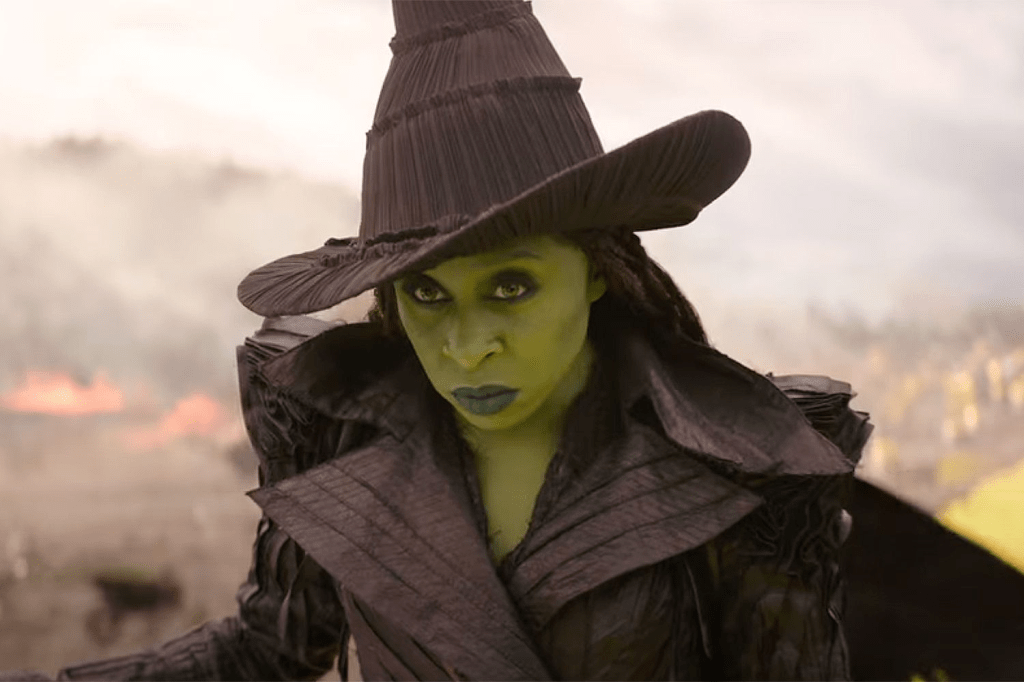
Wicked: For Good is a reasonably enjoyable film that brings the curtain down on the cinematic adaptation directed by John M. Chu. Winnie Holzman and Dana Fox are the scriptwriters, which is ultimately inspired by Gregory Maguire’s novel. The stage play was written by Holzman and Steven Schwartz.
Ariana Grande and Cynthia Erivo continue to do well in carrying as the lead roles of Glinda and Elphaba, who are more familiar in L. Frank Baum’s The Wonderful Wizard of Oz as Glinda the Good and the Wicked Witch of the West. Jeff Goldblum gives his usual distinctive, offbeat performance as the Wizard himself. Michele Yeoh, Jonathan Bailey, Ethan Slater, and Marissa Bode are also included in this extravagant cinematic feast for the senses.
This piece of the story picks up a year after Elphaba has defied the Wizard and fights for the rights of the animals of Oz. The famous Yellow Brick Road is about to open. Glinda is about to be married. A lot is going on as Glinda and Elphie’s friendship is tested to its limits. Meanwhile, a young girl has crashed into the mystical land when a storm brings a house hurling through the sky. This young girl and her little dog become unwitting key figures in the tumultuous destiny of Oz.
So, I finally saw this conclusion to this latest attempt at an epic cinematic experience. It does fall short of being a mind-blowing theatrical experience, but there are quite a few bright spots that keep me from regret.
Erivo and Grande do have a pretty distinct chemistry. Ariana herself seems to have surprisingly astute comedic instincts. I was also impressed with Erivo’s singing during her musical moments. Goldblum remains to be an interesting presence whenever he appears. There is no shortage of real talent in this cast.
The artistry in the sets, which makes heavy use of CGI, is also quite visually appealing. I am not sure how much was actually physically built, but I think I would have loved to hang out on the set if I were a part of this project.
The performances were pretty good on the whole. The writing was not great but not outrageously bad either when compared to much of what Hollywood has been peddling lately.
The film still felt a little too padded at times with scenes that droned on longer than needed. I am not sure that talking animals really needed to represent the oppressed populations when one could come up with the notion of using a group of people.
The idea of making traditionally villainous characters as being merely misunderstood is getting a little stale.
The film still left me with the sense of it lacking in real originality in many ways. I saw it and had my curiosity satisfied, and now I can shrug it off and go on to the next one…after I complete this blog of course.
I will grant it with one admission though. I am now a bit more intrigued enough to read the book by Gregory Maguire at some point and may actually follow through on that.





 Reviews, Musings, and Other Things...