Book Review: Not The Most Welcoming Inn

Jamaica Inn by Daphne Du Maurier is a gothic thriller first published in 1936 and reads a little easier than expected in spite of the typical lengthy exposition of its time.

The protagonist is Mary Yellan, a young woman whose mother has recently died. Mary is on her way to Jamaica Inn where she is to be reunited with her aunt. Aunt Patience is married to a man who is quote a brute and involved in some unsavory activities on the moors in Cornwall. Uncle Joss begins the new arrangement by bullying and intimidating Mary, who feels duty bound to remain at the inn to protect her aunt. Mary meets her uncle’s brother and becomes attracted to him against her better judgment. A peculiar vicar is also lurking around is may not be the ally he presents himself to be.

Mary gets a close look at what her uncle does to supplement his income and has even more reason to wonder how long she has before her life is on the line.

Du Maurier is best known for her novel Rebecca which was published later. She does have a distinctive eloquence in her prose, and I can appreciate how she became so respected.

The character of Joss Merlyn, the abusive uncle, comes across as a bit campy in his bluster. It got a little difficult at times to imagine him as authentic. The tension between Joss and Mary was quite compelling in any case.to read.

Du Maurier also does well with describing the hostile and oppressive environment surrounding the inn. Sometimes it seems to go on a little long, but one must also understand the time in which that was written and what was expected versus the short attention span of today’s audience.

This is a little bit of a departure from my usual reading interests, but I was glad to find this one.

Next up, I am taking on the Big Kahuna of the true crime genre. I am delving into the intricacies of the Charles Manson case as told by Vincent Bugliosi and Curt Gentry with Helter Skelter.

Book Review: Trouble In Cypress County

The Long Lavender Look is a decent novel written by the revered crime writer John D. MacDonald and features his best-known protagonist, Travis McGee. It was first published in 1970.

Travis McGee is a salvage consultant with a peculiar tendency to get involved in murder investigations. He lives in a houseboat called The Busted Flush in Florida and just has a talent of falling into dire peril involving greed, corruption, and murder.

This story begins when McGee and his friend, Meyer, are returning home from attending a wedding when a scantily clad woman darts across a darkened road right in front of his car, causing them to end up in swamp water upside down. As McGee and Meyer make their way to civilization, they are accosted by someone in a truck passing them taking shots at them. When they make it to the authorities, they find themselves arrested for the murder of a guy in Cypress County who was apparently involved in an armored truck heist some years prior. McGee finds himself in the middle of a complicated web of corruption where he is not sure who he can trust as he fights to clear his name and return home.

First of all, I will say that I will likely be revisiting this author’s works again, but MacDonald does require some patience because he is a bit wordy. His exposition at times slows down the story and kind of makes it a bit of a chore to get through.’

I do appreciate that MacDonald does display an impressive eloquence in his prose for what is classified as a hard-boiled crime novel. The friendship between Meyer and McGee has its charm as well. I had heard of Travis McGee for years but did not really know much about this series. I do like the set-up MacDonald has created for him. For example, The Busted Flush seems to be a great name for a boat.

MacDonald is generally considered one of the great ones in this genre, and I can understand how he gained that acclaim even though I struggled a bit with this one. I suspect that I have spent too many years with writers who are much more abrupt and simple in their prose to fully appreciate MacDonald’s writing style.

Once again, I may not be doing myself any favors by starting well into the middle of a series. MacDonald has numerous standalone novels, which I will also likely explore, but I doubt this will be my last effort to hang with Travis McGee.

I wish this particular novel hooked me more, but I am not ready to throw in the towel in my exploration of the works of John D. MacDonald.

My next read is going to take me further back in time to another legendary suspense writer named Daphne Du Maurier, who is most famous for the novel Rebecca. I thought I would be introduced to this author’s works by way of Jamaica Inn.

Book Review: Never An Easy Path For Mr. Rawlins

A Red Death by Walter Mosley is an interesting mystery novel featuring the author’s best-known protagonist, Easy Rawlins.

It is 1953 in Los Angeles, and Easy Rawlins has become a property owner who keeps his assets a bit of a secret due to the hostility he would likely face since he is a black man living in the midst of ongoing racial strife. The secret’s out when an IRS agent has reason to file a tax evasion charge against Rawlins. An FBI agent comes to Easy’s aid, but the aid is not going to be unearned. Easy is given the task to spy on an alleged communist who has volunteered at the First African Baptist Church. The matter turns more dangerous when people start getting killed, and Easy has to protect his life as well as his livelihood.

Easy’s life becomes even more convoluted when he falls his friend’s estranged wife. That friend known as Mouse is one of the most dangerous men in the city. That’s only the beginning of the pressures gathering around Easy Rawlins.

This is the second novel in the series featuring Easy Rawlins and follows Devil in a Blue Dress. Mosley is a talented writer and seems to capture the era well. I like Easy because he is not a saint. He also has some scruples and is easy to root for.

Mosley does write in the dialect that someone like Easy and his peers likely spoke, so that could be a little tricky to interpret correctly. It does give the characters and setting authenticity, so I don’t begrudge Mosley making the effort.

It was a good book, and I will likely revisit Easy Rawlins and see how his story unfolds. I recently confirmed that Mosley still brings Rawlins and drops him in the middle of trouble. Mosley actually has quite a bibliography in his wheelhouse, and I will likely pick up some more of his works.

My literary journey which is not going to end anytime soon will continue with another iconic suspense writer. I have not read this guy before, but I am about to rectify that. The Long Lavender Look by John D. MacDonald is the next to be picked up and hopefully enjoyed.

Book Review: Lew Archer Takes The Case

The Archer Files provided me with a welcome introduction to an author I had not read before. This is apparently the definitive collection of short stories by Ross MacDonald that feature his best-known private eye character, Lew Archer.

There are several stories and other material in this volume, so I don’t have the time and patience to analyze each entry. I will just merely recommend for any mystery fans to try this volume out.

There is a rather helpful and interesting biographical profile of Archer written by Tom Nolan, who edits and reviews crime fiction and apparently has done a thorough account of MacDonald in the past. I guess he is one of these experts in crime fiction. He seems to be a pretty good writer in his own right. I had no real issues with his introduction.

There are a dozen short stories that follow. Some are better than others, as one would expect, however none stand out as being really bad. Archer himself is pretty typical of other fictional, hard-boiled, protagonists of the era of the early Cold War days and the subsequent decades. He is does have a cool blend of toughness and intelligence. Archer is no slouch when it comes to his knowledge of literature and culture, but he’s certainly no push-over. He is a likable enough hero, and I will likely peruse a novel or two before long.

A somewhat more intriguing feature of this volume is a section known as the Case Notes. These are stories that MacDonald started and either just not finished or recycled the ideas into other works. It was interesting and a little annoying t the same time in that there were several stories that I was really wanting to know the resolution.

I am not sure that Ross MacDonald really broke much new ground in the genre at the time of his publications, but I can certainly see how he earned whatever acclaim he enjoyed during his lifetime. MacDonald died in 1983, and his real name was Kenneth Miller.

MacDonald certainly was not lacking in his writing talent. From what little research I did, it does seem that MacDonald has held in quite high esteem in the world of crime fiction, and as near as I can tell from my so far limited exposure to his works, that reverence from his peer seems pretty justified.

I am moving on to another highly regarded, long-standing crime writer who is still very much alive and quite prolific. It has been a couple of years, but I think it’s time to revisit Easy Rawlins as he gets himself into a bit more trouble with A Red Death by the formidable Walter Mosley.

Book Review: London Is All Grown Up

Edward Rutherford’s London is quite a literary feat with a page count that is over eleven hundred. It’s a great showcase for Rutherford’s prose style.

Rutherford takes his readers back to the time of Julius Caesar and creates several families as his vessels for exploring the rise and development of the great city of London. He creates quite a tapestry of historical events and personal struggles experienced by his numerous characters in his narrative.

Although this novel was not without moments of sluggishness in the plot, it is still an enjoyable reading experience on the whole. It was pretty thrilling to come across some of the historical events I recognized as not being that well-remembered. There are a lot of threads of which to keep track, and the sudden shifts in perspective kind of made things a little tricky.

There is no question that Rutherford is a talented storyteller. He also seems to have done an impressive amount of research which is laid out quite nicely.

It is a daunting book for many people, and I struggled a bit with retention of certain aspects of the novel. I think that may be more of an issue with my attention span rather than any downfall of the author.

I usually read simpler novels for my leisure time, but I like to challenge myself a couple of times a year at least, and London did satisfy that prescription. Even though I had some hurtles throughout the experience, I did enjoy the book and would recommend further examination of his other works. It may be a little while before I circle back to Mr. Rutherford, but I have no plans to avoid his other works. I was rather pleased with being able to take this on and stick with it.

I think it’s time to draw Harlan Coben out of the reading queue with Drop Shot, which features that sleuthing sports agent, Myron Bolitar.

Book Review: An Abandoned House, A Missing Doctor, And A Lot of Secrets About To Come To Light

Never Lie by Freida McFadden is an outlandish and improbable thriller that is a pretty entertaining ride for those willing to suspend their disbelief.

A newly married couple are in the market for a new house and arrive during a blizzard to an isolated manor that was once owned by a prominent psychiatrist who has been missing for a few years. Tricia and Ethan are trapped at the manor, which is curiously still completely furnished. Tricia finds a secret room containing a cache of cassette tapes that have the sessions with Dr. Adrienne Hale recorded. Tricia has an opportunity to see if the solution of the doctor’s disappearance is contained within these recordings. More old secrets and lies are about to be exposed, and Tricia learns that not everything is going to stay as buried as deeply as she hoped.

McFadden has become one of today’s most popular thriller writers, and she does have quite an imagination. However, she does rely pretty heavily on some very common tropes of the genre. Also, there is quite a lot of implausible coincidence that can be a little exasperating. Sometimes, the characters are not that believable. As mentioned before, the suspension of disbelief can feel a little taxing.

Still, I did enjoy the novel. There are some clever twists that kind of surprised even me. McFadden is not really an extraordinary writer, but she gets the job done. She might just be the ultimate popcorn writer of today. If it pays the bills, who am I to complain?

McFadden may be a bit overrated, but she at least avoids being just flat out bad, which is an impressive achievement in today’s literary climate.

This is only the second novel I have read by her, but I work in a bookstore these days, so I am aware of her popularity. I do like that she writes a lot of standalone novels, so I can dip in and out of her works without worrying too much about continuity. There are actually a lot of series that I don’t read in order, but I do recognize that it an advantage that McFadden has with her bibliography.

McFadden is at least fun to read, and I am certain that it will not be all that long before I am perusing her section on the bookshelves.

My next read has been in the queue for a while. I have been putting it off because it seems to be a daunting volume by Edward Rutherford. I am looking forward to trying it because it isn’t my usual genre of enjoyment, and I like to test my mettle a bit when it comes to my reading choices. It is also about one of bucket list destinations for travel. It is well past time that I learn the intricacies of London as only Edward Rutherford can tell it.

Book Review: A Most Peculiar Adoption

Unto Us a Son Is Given by Donna Leon is not one of the better novels featuring Venetian Commissario Guido Brunetti. It was first published in 2019.

Brunetti is invited by his father-in–law to a drink because he wants to lay out a concern over an old friend. An elderly art connoisseur in Venice is wanting to adopt a young man, and there does not appear to be much of a rational explanation for this move. Brunetti is asked to look into it and see if this young man has any trouble in his past. Brunetti agrees to take a look into it even though this isn’t his usual type of investigation. The old man drops dead in the street leaving the young stranger as an heir to his estate. Brunetti is back on familiar territory when another friend of the old man’s is strangled to death. He finds that the people in his life have more complicated pasts than even he realizes.

Leon describes the setting of Venice in loving and captivating detail. Brunetti is a pretty interesting protagonist with a stable family life.

Leon’s prose style is certainly distinctive and more than adequately displays her natural talent.

The problem I have with this novel is that it really seems to take a while for anything that interesting. The first death doesn’t occur until around halfway through the book. The murder takes a bit longer. It’s just kind of a slow book.

The plot itself is rather interesting, but it just takes too long to get moving. Leon herself is still a writer worth checking out, and I am sure it will not be too long before I look in on Guido Brunetti, his family, and fellow police officers.

The next selection on the reading queue is Holly by Stephen King.

Book Review: A Gruesome Delivery

Career of Evil by Robert Galbraith is another interesting installment in the Cormoran Strike series and is likely the most gruesome case yet. Strike is a former military investigator who has a prosthetic leg after losing his original limb to a bomb. He is a struggling private investigator who has also gained some notoriety after solving some high-profile murder cases in London. He has recently partnered with a former temp worker named Robin Ellacott, who has really been a huge assistance to the business.

Speaking of amputated legs, this little mystery begins with a severed leg showing up at Strike’s office. Strike quickly determines that one of his old adversaries is making a twisted attempt to rattle or threaten him. The reaction that Robin has when Strike comes up with four candidates capable of such a heinous act in his past is sort of amusing in a dark way.

More of Strike and Robin’s past is revealed here. Their friendship deepens until a seemingly rash decision threatens to wreck the trust they have built.

Robin’s upcoming wedding to a snarky Brit named Matthew is also on the brink of heartbreak. I am not sure if Galbraith is going to have a romantic union occur between Strike and Robin, but the progression in their relationship is compelling.

This is the third installment in the series, and Galbraith is getting better at fleshing out these characters.

Cormoran Strike is a pretty solid investigator in spite of his handicaps and hang-ups. I find him more likable and compelling with each novel. His relationship with Robin is just complicated enough to make things even more interesting.

There are some moments where the story is dragged down by a little too much exposition, but it’s not unforgivable. Most novels that come close to five hundred pages have that tendency. Galbraith’s writing style is just engaging enough to make the effort worth it.

Of course, Robert Galbraith is a pseudonym for J.K. Rowling, the mastermind behind the Harry Potter franchise. I have yet to read her most well-known works, but her works featuring Strike also showcases a formidable talent behind her keyboard.

Career of Evil also features an interesting homage throughout to the music of the band Blue Oyster Cult. Rowling seems to have a quirky imagination when it comes to adding quotes or pop culture references.

This is a pretty good addition to the series, and the tumultuous relationship between Strike and Robin is often as compelling as whatever investigation is at the center of the plot.

Eventually, I will get to the fourth novel, but not just yet.

Next up, Murder wrecks the Parisian vacation of one Chief Inspector Armand Gamache in Louise Penny’s All the Devils Are Here.

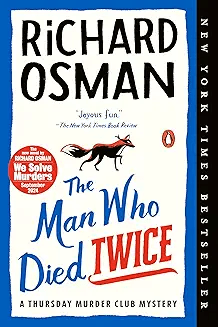
Book Review: The Thursday Murder Club Reconvenes

The Man Who Died Twice by Richard Osman is an amusing and effective second outing for the retirees Cooper Chase who have formed the Thursday Murder Club.

Elizabeth’s ex-husband emerges from her mysterious past on the run after being accused of stealing diamonds. Ibraham gets mugged. Ron and Joyce are there to lend their support as these two troubling events are the precursor to more murder and duplicity. The Thursday Murder Club, who meet once a week to discuss unsolved cases, get a crack at their second active case.

Elizabeth’s past kicks off the latest caper. Her charming, roguish ex-husband has turned up asking for her help to protect him from an irate mobster who believes him to have stolen a lot of diamonds worth an obscene amount of riches. The club’s police officer allies are after a vexing drug dealer, and an awkward romantic relationship is brewing.

Ibraham is understandably shaken by his attack, but he is still able to be of some help even if he is hesitant to leave the safety of his apartment.

Three bodies have turned up which galvanizes the club into searching for the purloined diamonds as a clever killer lurks within the retirement village.

Osman does another fine job of undermining any expectations or prejudices when it comes to the elderly. The four friends remain as quick-witted as ever. The friendship and support they offer each other is rather charming, even if they express some mild exasperation.

The reader gets a better idea of how efficient Elizabeth likely was in her prior occupation as a spy. The banter between her and Joyce often gets quite hilarious.

Ibraham is a former psychologist, so it’s interesting to find him struggling with fears and insecurities that were likely afflicting many of patients.

Elizabeth being a former spy does open up some interesting doors when it comes to plot. A series like this does lend itself to predictability, but Osman effectively avoids that criticism by delving into Elizabeth’s past a bit.

Osman has created a rather distinctive, charming series in which he challenges preconceptions of the elderly. This group of old people would be fun to hang out with.

In spite of the loads of humor throughout the novel, Osman does explore the tendency for many to underestimate older people who may still quite a bit of grit left in them. The friendship between the four main characters is at times a bit moving as well as amusing.

The case itself turns out to be pretty cleverly plotted with some pretty good twists. Elizabeth at some point realizes that the solution is simpler than she first thought. Although she is basically the leader of the club, all of the members get to shine a bit.

The strange choice of having some of the chapters presented as diary entries written by Joyce adds to the quirkiness of the series. It does work that the whole novel isn’t written entirely from her perspective, but the occasional account from her sort of adds to the charm.

Osman continues a rather implausible yet fun, so I am looking forward to catching up with the Thursday Murder Club when another case is added to the agenda.

Robert Galbraith is going to reveal a bit more of Cormoran Strike’s past in Career of Evil.

Book Review: Holmes, Marple & Poe Investigations Is Open For Business

James Patterson kicks off what appears to be a new series with a promising thriller entitled Holmes, Marple & Poe. Brian Sitts shares the writing credit as well. Although, this could mean that Sitts actually wrote it under Patterson’s banner. Anyway, the novel contains kind of a fun plot and characters that were rather intriguing as well as implausible.

Brennan Holmes, Margaret Marple, and Auguste Poe have emerged from some murky pasts and unite to form a high-class private investigation agency. Each member shares some familiar characteristics with their famous namesakes. Brennan Holmes has a similar scientific approach to Sherlock’s; however, he also has a very keen sense of smell that is often useful as well as overwhelming. Margaret Marple is considerably younger than Jane Marple, but she is able to encourage a bit of underestimation much like the famous spinster sleuth. Auguste Poe does have a vice that ended up killing his namesake, who isn’t a fictional character. He is also very knowledgeable about weapons and is very find of beautiful women, but he has demons that have yet to be laid to rest. There are a variety of cases that converge on the agency, including an apparent kidnapping and art heist. They also come across a perplexing serial murder case.

A NYPD detective starts her own investigation into the agency and finds the partners as enigmatic as the cases themselves.

I had some fun reading this one, probably because I am a sucker for most anything referencing Sherlock Holmes and Agatha Christie. I am not a necessarily a Poe fan, but I appreciate the cultural impact he had on the literary landscape.

I enjoyed how Patterson and Sitts weave the stories around each other, and the reader gets to see how the trio copes with different cases. They trade off who takes the lead on each case, which is kind of cool. The sleekness of the operation as a whole is somewhat too fanciful to buy into, but I suspect that’s par for the course for a Patterson novel. It wasn’t so outlandish that I found it exasperating. I have not read many of Patterson’s works, and I am not likely to be one of his most rabid readers. I also am not really swearing him off, and I will likely dip back into his catalogue occasionally.

Patterson writes very short chapters. This one has 118 chapters stuffed into 359 pages. I am not a fan of these absurdly short chapters. I also don’t like really long chapter. I guess I just want a chapter length just right, whatever that would look like.

In spite of these minor annoyances, I still enjoyed the novel and will likely revisit this particular trio.

I enjoyed the introduction to this trio well enough, but the required suspension of disbelief was almost too demanding.

There were some pretty good plot twists throughout the story. Even though this is not exactly to be considered highbrow literature, I was impressed with the imagination displayed by the authors here.

This book seems to be a love letter of long-time mystery readers, and I wouldn’t mind another one.

The Thursday Murder Club catches another case in Richard Osman’s The Man Who Died Twice, so it seems like a good time to revisit Coopers Chase.