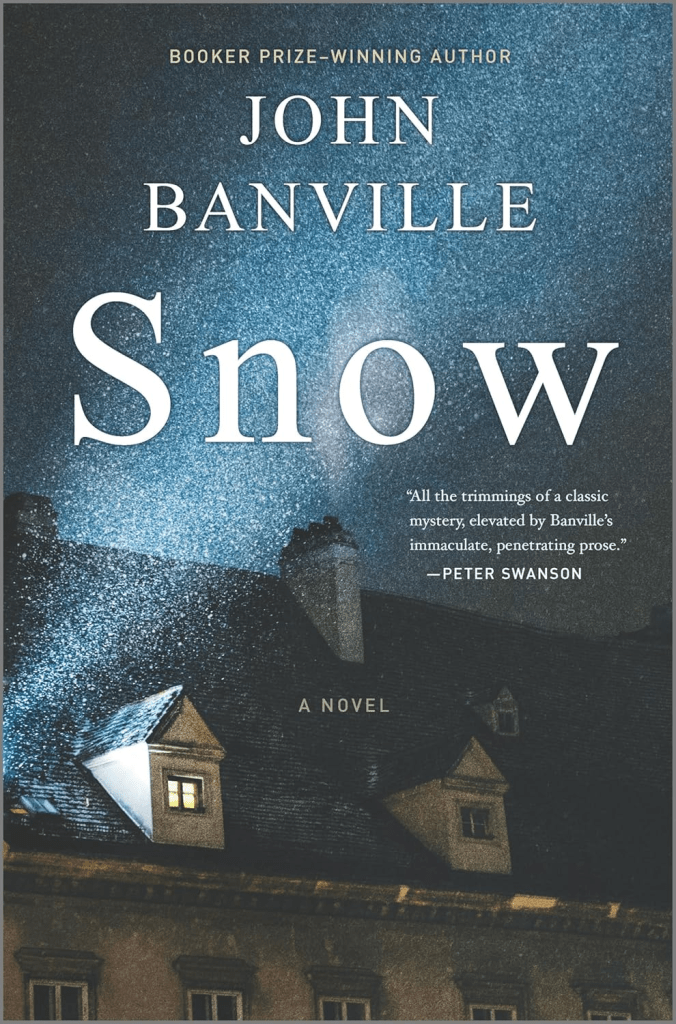
Snow is an unfortunately predictable murder mystery written by John Banville. The story takes place in Ireland during the year of 1957. A young detective named St. John Strafford is the protagonist investigating a gruesome murder of a Catholic priest.
Detective Inspector Strafford is understandably perturbed by the murder and mutilation of a priest in a manor owned by the influential Osborne family. The case takes an even stranger turn when his deputy disappears. Strafford is told that the priest was popular in the community, but some very dark secrets are unearthed, and the victim may not be as virtuous as one would hope.
It’s an interesting setting. I have an automatic affection for stories that take place in Ireland. I just had a hard time staying interested in the plot, and Strafford doesn’t really draw me in. He seems kind of boring, honestly.
The motive for the murder is something would easily expect considering that it’s a Catholic priest who is the target. He was castrated, so it’s not hard to guess why the killer took that extra step.
Banville does have a nice prose style. He isn’t a terrible writer, but this particular novel may have just been the wrong one to introduce me to him.
My efforts to read new authors sometimes misfires, and Banville just didn’t do it for me.
Time to move to an old favorite of mine in the world of fictional detectives with Robert B. Parker’s Broken Trust, which is actually written by Mike Lupica, who has continued the Spenser series since Mr. Parker has been deceased for some time now.
Vengeance is Mine by Mickey Spillane has Mike Hammer in a dangerous predicament from the first line of this classic crime novel from one of the acclaimed masters of the genre.
New York gumshoe Mike Hammer starts off the story with a nasty hangover and a corpse in a hotel room with police already scrutinizing him. The victim is a friend of Hammer’s named Chester Wheeler. The police determine that Wheeler committed suicide with Hammer’s gun after the two of them went out drinking. The district attorney does use the mess to pull Hammer’s private investigation license and gun permit. Hammer has reason to believe that his friend was actually murdered and is motivated to start his own investigation that takes him to a suspicious modeling agency and a blackmail scheme. Wheeler is not the only one to lose his life, and the subsequent murders seem to confirm that Hammer’s instincts are dead right.
The novel was first published in 1950, so there is a bit of adjustment to the writing style of the time. Of course, Spillane’s works was seen as quite raw for that time. This period was the height of noir crime fiction, and Spillane has earned his crown quite legitimately here.
Hammer is one of the more brutal protagonists in the genre. He is also a bit conflicted when it comes to matters of love. He has women who want something more from him than he feels he has. There are some fictional detectives that are a bit more compelling, but Spillane does a pretty good job. I can see why he is so popular among the crime fiction enthusiasts.
This novel was an enjoyable literary diversion, but I don’t know if this is one of the masterpieces in Spillane’s bibliography. It’s a fun read but not for the squeamish.
Next up, murder has struck Ireland in the 1950’s, and the matter falls on Detective Inspector St. John Strafford to resolve in John Banville’s Snow.
Jago & Litefoot Series Three is a pretty decent addition to the audio series reuniting the two Victorian investigators of infernal incidents with an old friend in the shape of Leela, portrayed by Louise Jameson. Christopher Benjamin and Trevor Baxter reprise their celebrated roles of Henry Gordon Jago and Professor George Litefoot in this new collection of episodes released by Big Finish Productions. Lisa Bowerman returns as Ellie, their favorite barmaid. Conrad Asquith reprises his role as Sergeant Quick. There are four episodes to discuss briefly here.
Just to review, the Jago & Litefoot series is a spinoff of Doctor Who. They met during the television serial entitled The Talons of Weng-Chiang during Tom Baker’s era in the role of the Doctor. Louise Jameson returns to lend a hand in this series as Leela. Leela has been sent from Gallifrey to help close some time breaches which have been plaguing Victorian London. It’s fun to hear them banter back and forth once again.
The first story to discuss is Dead Men’s Tales by Justin Richards. Beings known as Wet Men have been lurking around the streets and alleys of London. They have risen from the Thames looking for a lost member of their crew. The idea of ghosts from the future are first explored here.’
Leela gets to go undercover as a barmaid under the tutelage of Ellie Higson, portrayed by Lisa Bowerman, and the moments is hilarious. Jameson is quite an experienced actress and handles the moment quite deftly.
Anyway, it’s a fairly interesting story, but Richards has done better in the past.
The Man at the End of the Garden by Matthew Sweet explores the idea of a fairy tale coming alive. It was an okay script, but it was not that memorable. I did like that Big Finish actually cast a child for the role of a little girl at the center of the problem. They do not always do that. Eden Monteath is the name of the young actress, and she did a good job. The cast interviews at the end revealed that she took the part seriously but likely had fun as everyone attests to happening when recording at the studio.
Jago and Litefoot get a taste of the future in John Dorney’s Swan Song. More ghosts from the future haunt the New Regency Theater, which was recently bequeathed to Henry Gordon Jago. In the future, a lab will be built where time experiments are being conducted. This was a much more engaging story than its predecessors, but that’s not surprising considering it’s from Dorney.
Finally, another long time Doctor Who contributor, Andy Lane wraps up this set with Chronoclasm where the mastermind behind the disturbances is revealed. Philip Bretherton steps from the shadows as Elliot Payne. Jago, Litefoot, and Leela get some unexpected help from another Henry Gordon Jago.
It’s another competent script from a talented writer, but Lane has also done better in previous works.
Overall, it was an enjoyable listening experience, but the inclusion of Leela just seems like such an obvious move. Still, Louise Jameson does that part so well, so it was still nice to have her join in the hijinks.
The set serves the purpose of being enjoyment accompaniment in the car, but there is not much that I found to stand out other than the guest appearances.
Copper River is my first sampling of William Kent Krueger’s writing and is unlikely to be my last since I enjoyed this novel quite a bit.
Krueger has a protagonist named Cork O’Conner, a sheriff in Minnesota. O’Conner has apparently had quite a difficult time in the previous novels that I have yet to read. He starts off this story with a bullet in his leg and in hiding from a crime family who believe that he had killed one of their members. He ends up in Bodine, Michigan where he has a cousin that is able to meet some of his medical needs. The cousin, Jewell, is a widow with a young son, who is able to help with the bullet wound.
Cork’s investigative instincts awaken when a body is discovered in the river. A young girl has been murdered, and Cork needs some help when it appears that there is a conspiracy involving runaway teens. The killing doesn’t stop with one girl in the river. Cork has his own troubles and needs to get back to his wife and children, however he is not going to leave his cousin and her to face their threats without him.
Krueger is a pretty good writer and is not afraid to put his main character through the wringer. O’Conner is a typically pragmatic and likeable law enforcement officer. Of course, I am meeting this character in the middle of the series, but Krueger does a decent job of catching up the reader on events in the more recent novels without it seeming too clunky.
Apparently, Krueger also has some interest in Native American culture and history which he peppers in quite effectively.
Anyway, Krueger is a writer I am going to revisit in the not-too-distant future.
Next up, I haven’t read a Mickey Spillane novel in a while, but I do happen to have “Vengeance is Mine” in my stack of books on the dresser.
What Child is This? is an adequate Sherlock Holmes novel written by Bonnie MacBird. It takes place during the Christmas season of 1890.
Sherlock Holmes and Dr. John Watson foil an attempted kidnapping on the streets of London and are engaged by the mother to identify the would-be adductor. The father of the child has made his own arrangements for an investigation. Also, another case of a wayward son presents itself when an aristocrat shows up at Baker Street to enlist the assistance of the consulting detective. Holmes is engaged to ensure some peace for two families in time for Christmas, but he and Watson have to navigate some dangerous waters so they can find some contentment in the holiday as well.
Bonnie MacBird is one of the better writers to carry on the legacy created by the late Sir Arthur Conan Doyle, but this is not one of the better ones in her series of Holmes novels. Holmes does display a certain compassion that can be overlooked in other pastiche works at times, so that is kind of a nice touch.
I just found myself less than enthralled by the cases Holmes was investigating. My interest was only mildly piqued from time to time.
There were some illustrations peppered throughout the book that were done by Frank Cho. I didn’t hate this entry into the series, but I was sort of just going through the motions in reading this.
I am still interested to see what MacBird’s next Holmes venture will contain. She is a talented writer, but she rather missed the mark with this particular release.
Now that is done, the next reading indulgence is going to be a visit to Copper River, where Sheriff Cork O’Conner, recovering from a gunshot wound, has involved himself in a very disturbing murder investigation that also involves abducted children. I have yet to read one of the thrillers by William Kent Krueger, but Copper River seems to be a promising introduction.
The Mystery Writer by Sulari Gentill is an implausible, yet still enjoyable thriller dealing with new starts, eccentric families, and disturbing conspiracies.
Theodosia Benton is a young woman who has left law school and shows up on her brother’s doorstep with aspirations to be a writer. The Benton siblings are originally from Australia, but Gus Benton has established himself as a formidable attorney in Lawrence, Kansas. Theo begins her wiring project as she starts her new life under the care of her older brother. She meets a fellow writer, who takes on a mentor role in her life. When the relationship starts to develop into something more personal, the mentor is murdered quite brutally. Gus falls under suspicion, which forces Theo to take some drastic actions to protect her beloved brother. The more Gus and a good friend named Mac Etheridge start to uncover, they find that there may be a darker conspiracy at the root of their troubles.
Gentill takes her readers though quite a journey to arrive at the truth. Her characters were pretty interesting. The plot becomes a bit outlandish, but Gentill still makes it work. There are some interesting twists and surprises. I liked that there were some time jumps in this one. The story does not reach its resolution all that quickly for the characters.
Gentill has a writing style that flows pretty easily without seeming too boringly rudimentary. The characters are pretty likable and easy to care about. It seems that both Mac and the Bentons grew up with unconventional families. Mac’s family are conspiracy enthusiasts and doomsday preppers, yet it’s hard to not find them charming when comes onto the scene. Mac obviously loves his family but does find them somewhat exasperating.
Gentill does pepper some humor throughout her tale, but some serious revelations about the Bentons’ past comes to light.
Gentill seems capable throwing in some impressive twists which seems to be getting harder to do in this genre. I don’t know if she is the greatest mystery writer of the age right now, but she is certainly interesting enough for me to keep an eye out for her other works.
The Christmas holiday is behind us, but that’s no reason to avoid revisiting the Yuletide season during the 1890’s from the rooms of 221 B Baker Street, especially since Bonnie MacBird has continued her series of Sherlock Holmes novels with What Child is This?
Code Red is a recent continuation of the Mitch Rapp series of thriller novels originated by the late Vince Flynn. Kyle Mills has written his final contribution to the series and leaves the franchise with a pretty decent addition.
Mitch Rapp is a top counterterrorism operative for the CIA, and yet he owes a favor to someone who is rather despicable. A Mexican cartel leader has called in a marker and wants Rapp to travel to Syria to look into the creation of a powerful narcotic that is interfering with business. Rapp poses as a Canadian lawyer and has to behave a bit more civilized than he is used to operating. Rapp is a stone-cold killer when hunting for terrorists or anyone who poses a threat to the United States. He soon discovers that the proliferation of this drug is actually a form of attack from the Soviet government. Rapp is basically on his own since his latest mission isn’t really sanctioned by the US government. He also has good reason to not trust the man for whom he is working this time. He is quite well that he is seen by the crime lord as being very expendable. None of these obstacles will deter Rapp from protecting his family and those he has come to love. That also means there is going to be quite a bit more killing that will be done.
Mills does pretty well here. I was rather amused at the scenes where Rapp has to pretend to be paralyzed with fear when he is abducted while in his guise. Little do the bad guys know that their victim is the most dangerous man in the room. Rapp doesn’t really do undercover gigs, so it was refreshing to have him employ a tactic that he so rarely uses.
The villains are typical of this series. I do find it interesting when Rapp ends up going after someone other than another Middle Eastern terrorist. I believe this is the second recent novel that Russians were more of a target of Rapp’s lethal talents, and I sort of like the change of pace.
Also, the recent novels have Rapp basically in a stepfather role, and it’s pretty cool to see a paternal streak revealed.
I miss the original creator, Vince Flynn, but Kyle Mills was a solid choice by the publishing house to continue the series. He is a competent enough writer and was courageous enough to place Rapp in situations that may not have been explored by Flynn. Still, Vince Flynn was taken too soon. and too young. I would have loved to have known which direction he would have taken Rapp, but I think Mills does well enough honoring the legacy.
Don Bentley is now the successor for continuing Mitch Rapp’s bloody mission in protecting America from its numerous enemies.
Next up, I will be reading The Mystery Writer by Sulari Gentill.
The Perfect Son by Freida McFadden is an interesting and competent thriller about how far a mother can go to protect her son even if she is not sure of his innocence of a horrific crime.
The Cass family seem to be a typical American family. The older son, Liam, is a popular, charming teen-ager, however the Erika Cass has picked up a strange distance in him. Liam may be a dangerous sociopath who is getting too old her his mother to control. When one of his classmates goes missing, Erika fears the worst, especially when the police show up on their door.
This has been a plot that has had a few iterations over the years. The seemingly perfect child who is more dangerous than he appears is kind of overused. McFadden is a competent writer though, so it’s no worse than anything else with this type of story.
It’s told in first person with most of the narration alternating between the mother and a classmate of Liam’s who has a pretty intense crush on him. It’s a pretty quick read, and McFadden does well with ratcheting up the tension throughout. Unfortunately, her plot twist isn’t that hard to predict, but it’s still a pretty good read for us thriller aficionados.
Vince Flynn was a novelist who died several years ago, but his creation Mitch Rapp lives on with the continued writing talents of Kyle Mills. Mills has moved on from the series since writing my next read, but Rapp is not going anywhere as another writer steps up to continue. I have one more Mills installment to read, and that would be Code Red.
Dodge City: Wyatt Earp, Bat Masterson, and the Wickedest Town in the American West by Tom Clavin is a fascinating account of how one of the wildest settlements in the expanding nation was tamed largely by two legendary figures what is known as the Wild West.
Clavin is a prolific historical writer who specializes one of the most fabled eras of American history. He presents the reader with an interesting problem at the beginning. He reports that there is almost too much material to sift through regarding Wyatt Earp, but there is relatively scant information about Bat Masterson. He still manages to present fascinating histories of both of these men we well as other familiar names such as Doc Holliday, Jesse James, and Billy the Kid.
Clavin’s prose is pretty straight-forward, but he does pepper the book with some sly humor. He does acknowledge that there is a lot of falsehoods to weed through in his research. He is pretty clear as to when he is speculating as to how certain events went down, which is appreciated.
He said that much of the exploits of Earp and Masterson have been embellished by other writers and the media over the decades, but it seems their actual lives were much more enthralling than many led regardless.
There isn’t much to really criticize about this book. Not everything was laid out linearly, but I suspect that many books of this sort are like that. There is a bit of jumping back and forth in the timeline as Clavin has to divide his attention between two main figures of 1870’s
Clavin is very thorough in his research and seems to be forthright about some of the ambiguity in the information he had gathered. As mentioned before, he does a great job of identifying moments of speculation and some guessing as to what motivated certain people in certain events.
This is a rare reading indulgence for me. I don’t read much non-fiction; however, I hope to improve on that this coming year. I will likely revisit the works of Tom Clavin before long.
Anyway, for those interested in a more reliable account of the Old West, Clavin seems to be an excellent place to start. Dodge City is a very enlightening and entertaining read and provides what seems a probable accurate take on what life was like in one of the most turbulent periods in American lore.
I will return to thriller genre with a writer I have noticed recently who seems to have quite a bibliography for someone who seems so new to the literary scene. I am about to be introduced by Freida McFadden to The Perfect Son.
The Bad Weather Friend is one of Dean Koontz’s more bizarre additions to his bibliography, but it’s pretty entertaining and not without some creativity.
An amiable realtor named Benny Catspaw suddenly has his life come apart at the seams when he loses his job inexplicably. Even more troubling is when his fiancée ends their relationship. As Benny is trying to understand this onslaught of misfortune, he suddenly receives an unexpected message from a man claiming to be a previously unknown uncle. A crate is delivered which Benny later finds contains a giant of a man called Spike who says that he is a being who is assigned to people who are apparently too nice for this world. Benny also meets a waitress who is an aspiring private eye, and she is an enthusiastic ally. During the present-day adventure, Benny recalls his peculiar family history and his time at an unusual boarding school where he did have a couple of friends. Benny finds that he has been targeted by a powerful group, but he has a rather interesting being known as a craggle working on his behalf as well. Spike is sworn to keep Benny from the worst the world is able to throw at him and will employ some unusual and fantastic tactics to do just that.
Koontz remains an imaginative and witty author. This story is rather strange but pretty entertaining. Koontz is pretty skilled at the art of witty banter. The protagonists are likeable enough. Spike is a rather unique creation, but the story sort of loses some sense of suspense because he is pretty invulnerable.
The themes in this novel are little too familiar in Koontz’s works. Once again, it is someone with an ideal sense of morals and outlook on life. The villains that are revealed are a little too cartoonishly narcissistic to be really believable, but I suppose such people do exist. Koontz also is back into the realm of strange conspiracies and shadow organizations, which feels annoyingly repetitive.
Koontz does have a distinctive turn of phrase which keeps the story compelling. There are some pretty amusing passages throughout the novel.
Koontz does seem to be a literary one-trick pony sometimes, but this novel still is worth the time. I read a lot of Koontz in my younger years, and I don’t regret revisiting his prose this time in spite of mixed reactions to this particular novel.
The lifelong reading binge continues with C.J. Box’s Free Fire.






 Reviews, Musings, and Other Things...