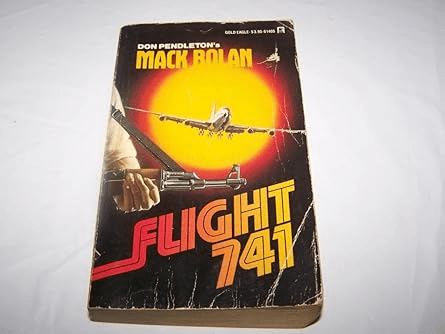
Book Review: When Terrorists Meet An Executioner

Flight 741 is a 1986 adventure novel featuring Mack Bolan who is also known as the Executioner. Bolan was created by Don Pendleton many moons ago. I think the author of this particular one is a guy named Mike Newton who is given some sort of credit on the copyright page.

Anyway, this is obviously a leisure read in the extreme. It’s a fun indulgence but nothing too surprising here.

Mack Bolan is a super antiterrorist operative who has appeared in numerous novels probably about thirty to forty years ago. He was part of the men’s adventures range of Gold Eagle publishing. Each book had a significant body count because Bolan was not one to bother with courts and trials when it comes to terrorists.

In this particular installment, Mack Bolan is traveling under an alias from Munich to New York when his flight gets interrupted by a hijacking. He takes a pretty brutal beating when trying to save a flight attendant from certain indignities. Once the ordeal is over, Bolan is thirsty from some good old-fashioned vengeance. Unlike the most people, Bolan is more than capable of getting it. He embarks on a pursuit of a known terrorist who goes by the moniker of “the Raven” and finds this guy to be quite elusive, especially since he employs body doubles. He comes across an old flame who is no stranger to this type of danger, and his ruthless hunt is now tempered by his desire to keep another girl safe from aforementioned indignities. Anyway, Bolan is justifiably angry, and a group of crazy hijackers and their sponsors have well earned their executions.

So, the Mack Bolan series is not something to stimulate the higher intellects of the world. It is brutal and can really crank up the testosterone levels if one has an overactive imagination. It’s great even if the writing is not the best. No one is going for the Pulitzer here.

I liked the book because most of it is the aftermath of the hijacking and how Bolan settles the score. There are different perspectives, and the reader gets some more insight into the history of the villain as well. It’s still great when Bolan catches up to him and lives up to his own codename.

There are some efforts to flesh out supporting characters which I appreciated. There was some display of tenderness from Bolan when it came to his lady friend, Toby Ranger, who end up in danger. Bolan is the good guy, so that was not surprising, but it did lend itself to giving some depth. In spite of his more brutal proclivities, there is a sense of gallantry I can respect.

This isn’t a great novel by any means. The genre doesn’t quite lend itself to that, but it was enjoyable enough to make it likely for me to pick up another Mack Bolan escapade in the near future.

My next step on the pleasantly unending literary journey brings me back to Edward Rutherford with his novel of historical fiction entitled Paris. I had read London some time ago and enjoyed it, so I think I will see what his take on the City of Light.

Film Review: Unknown No Longer

A Complete Unknown, directed by James Mangold, turns out to be a pretty compelling biographical film about the early career of Bob Dylan, played by Timothee Chalamet. Mangold also co-wrote the script alongside Jack Cocks. It was based on the biography entitled Dylan Goes Electric by Elijah Wald. Edward Norton also has a substantial role as Pete Seeger, the folk singer and activist who helped introduce Dylan’s music to the masses. The cast also includes Scoot McNairy as Woody Guthrie, Elle Fanning, Monica Barbaro as Joan Baez, Boyd Holbrook as Johnny Cash, and Will Harrison as Bobby Neuwirth.

The story begins in 1961 when Dylan has moved to New York and sets out to meet his musical idol, Woody Guthrie, who at this point is hospitalized with Huntington’s Disease. Dylan also happens to meet fellow folk singer, Pete Seeger, who is also visiting Guthrie. He impresses both of them with an impromptu performance in the hospital room of one of his songs. Seeger invites Dylan to stay with him and his family and introduces him to the folk music scene. Dylan’s music captures the audience’s attention and so begins his rise. A major conflict arises when Dylan wants to be known as something other than just a folk musician. Apparently, when he started turning to electric guitars, that cause some ire among the fans and colleagues who preferred to pigeonhole him. Dylan has to navigate some challenges in his personal and professional relationships as he desires to create his own path within the music industry.

First of all, the performances are quite good. I am not that familiar with Dylan and his eccentricities, but it seems like Chalamet probably hits the right notes. Edward Norton, unsurprisingly, is also compelling. The film does a good job of inspiring those who may not spend that much time in folk music to look into a deeper into the genre and the major artists. The film has a top-notch cast.

The film is quite good but not free of some admittingly minor downfalls. There are moments where it seems to drag, even though it is focused on a mere three- or four-year period of Dylan’s life. There again, that is pretty tolerable because of the cast.

I thought the friendship between Johnny Cash and Dylan was kind of interesting and could have used a little more exploration, but that could be for a different film. I am not that sure how close Boyd Holbrook gets to actually emulating Cash, but I found that I liked his presence all the same.

One thing I noticed about the story is that it really reveals how mercenary the music industry can be even in the 1960’s and even when it concerns the music of the hippies and protesters. I did find myself sympathizing with Dylan’s plight, which is no doubt the intention of the film. I am not really a Dylan fan, but I did find this bit of his story rather compelling and may develop a deeper appreciation for his talent and music, even though we would likely wildly disagree on numerous political and social topics.

Book Review: Joe Pickett Gets Back On His Game

Free Fire by C.J. Box continues the compelling saga of now former game warden Joe Pickett and his family as he is given another chance to regain his job when he accepts a confidential assignment from the governor that takes him to Yellowstone National Park.

Pickett had been dismissed from his game warden position in the previous novel and starts off this one working as a ranch hand for his mother-in-law’s new husband. A case has broken when a murderous lawyer slays four people in a corner of Yellowstone National Park that is some kind of legal free fire zone. There may not be a way to prosecute this attorney, but Pickett is tasked with uncovering a motive. When some of his new colleagues are attacked or killed, Pickett starts to understand that there are some secrets that threaten many people, and some of those are willing to add him to the body count.

Box hits on an interesting idea that one can lure his intended victims to some zone where the normal laws prohibiting murder don’t apply as they would in anywhere else in the country.

Anyway, I found the novel enjoyable, but I am likely a pretty consistent C.J. Box reader. There isn’t much that’s groundbreaking, but it remains interesting. Pickett and his family remain compelling because they try so hard to be conventional and normal in many ways, but they keep getting thrust into dangerous situations because of his career.

It’s a pretty enjoyable and interesting entry into the series, but it’s not quite a homerun.

Next up, I am returning to the realm of the supernatural with House of Secrets by Darcy Coates.

Film Review: Bob Marley Wails His Way Around The World

Bob Marley: One Love is not a terrible biographical film about the legendary reggae artist, but it is rather underwhelming overall. It has a few bright moments and could have been something special if some different production choices were made.

Reinaldo Marcus Green directed the film which he co-wrote with Terence Winter, Frank E. Flowers, and Zach Baylin. Kingsley Ben-Adir stars in the lead alongside Lashana Lynch, James Norton, Tosin Cole, and several other talented enough actors. One of those actors was none other than Michael Gandolfini, son of the late James Gandolfini.

Ben-Adir is a charismatic enough performer and likely captured the essence of Bob Marley pretty well. As near as I could tell, he did his homework when it came to breathing life into the role. The cast did appear to be well-chosen. Lynch was quite compelling as Rita Marley, Bob’s wife. I have no real issue with how the film was cast.

The film largely focused on a three-year period not too long before Marley’ s death in 1981. There is some political upheaval going on during this time, and Marley has decided to appoint himself as some kind of peacemaker through his music. Near the beginning of the film. he and his wife are shot but only wounded. His fame grows across the globe as he sends his wife and children to stay with his mother in Delaware. The film is leading up to a famous event called the One Love Peace Concert which occurred in 1978.

Critics of the film raise have some valid points, however. Because of the Jamaican dialect, much of the dialogue was hard to make out, which was quite distracting. When characters got excited and were a little irate with each other, it was particularly difficult to follow what was going on in those moments. The progression of the story was a little disjointed at times. I was not sure what was behind the unrest in Jamaica at the time. I know I could look that up and figure that out, but the film could have done its part and explained it. I just knew that Jamaica was on a powder keg at the time, and there was quite a bit of violence and crime erupting all over the place. The writers could have been a bit more generous with the background information without bogging the film down.

The music that was chosen was pretty good. There were a couple of scenes with Marley kind of jamming with his band during house parties or rehearsals that were quite engaging. The concert scenes were captivating as well. I did enjoy the music even though reggae isn’t really something I have gone out of my way to listen to.

Anyway, I left the theater a little disappointed that Bob Marley didn’t have a better cinematic depiction. This was produced by his son and members of his family, so it seems that some more complicated or unflattering aspects of Marley’s background were glossed over. That’s kind of understandable, I suppose, but there are not enough merits here to let that slide without comment.

I have obviously seen worse films, but I was hoping that this one would stir me a little more than it did. I did appreciate some more exposure to Marley’s music, and I do concur with the general impression of his musical talent. I may need to add him to my Pandora playlist, but I wish the latest film about Bob Marley left a more favorable impression as well.