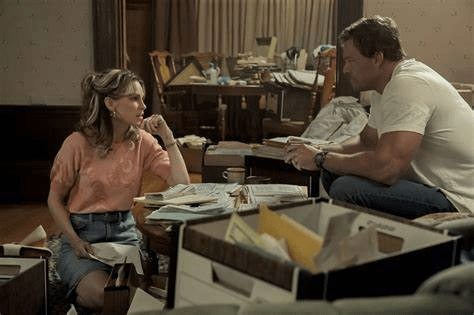
Ordinary Angels is a drama film directed by Jon Gunn, that is somewhat predictable and often implausible, but it still manages to hit the heartstrings just right.
The screenplay was written by Meg Tilly and Kelly Fremon Craig. Oscar winner Hilary Swank is paired with Alan Ritchson as the leads. Nancy Travis and Tamala Jones are included in the cast with Amy Acker, who is onscreen too briefly as the deceased wife and mother. Two young daughters of Ritchson’s character are played by Skywalker Hughes and Emily Mitchell and are very well cast.
The storyline concerns a widowed father of a young girl in dire need of a liver transplant. The bills are crushing his spirit and his ability to better provide for his family. Swank plays an alcoholic hairdresser named Sharon Stevens who is moved by the family’s plight and takes it upon herself to shake the community into helping in the most extraordinary ways. Sharon comes across as bombastic and stubborn, but she is carrying a secret heartache of her own. The motivations behind this sudden altruism bear a bit of scrutiny, however there is no denying that she knows how to get results.
The plot is pretty simple, and films like this are not in short supply. Once again, the performances really make it work. Swank, in particular, had a role that could too easily become a caricature, but she manages to show enough restraint to not go too far over the top. Ritchson, who has recently found further fame as the stoic, indomitable Jack Reacher, also demonstrates a somewhat unexpected range in a captivating performance as the hapless, prideful father who feels a bit out of his depth when dealing with the bossy, but well-meaning hairdresser who has barged in his family’s tragedy.
Everyone in the cast delivers a solid, heartfelt performance. The two girls playing the daughters were quite believable and charming. There were times where it was easy to believe that Ed Schmitt, played by Ritchson, could have a moment where he could put his worries aside and just love his children in spite of the apparent oncoming heartbreak that is hovering over them.
There is so much to appreciate about this film, but it is not without some drawbacks. Some of the circumstances surrounding the girl’s illness and the coincidences depicted that ended up helping to resolve the crisis seems a little too implausible at times.
I have yet to read the comparison between the film and what actually happened in the real world, but it was too easy to get distracted by the apparent artistic liberties at times.
The Schmitt family and their unexpected friendship with Sharon is really a true story, but some elements in the film still felt a little exaggerated, which is a par for the course for anything coming out of Hollywood.’
I do wish that the writers were able to make more use of Amy Acker. I understand that she has the character who dies at the beginning, but there could have been some flashback moments or something. Acker seems to have enough of a filmography and more than enough talent that should require more than two minutes of screen time, and I just think there could have been more of an effort to have her audience spend a little more time with her.
The overall experience is a bit of an emotional rollercoaster, and although it’s not always a fun ride, it’s memorable and ultimately enjoyable.
I was also pleased that God was acknowledged in a way that felt genuine and reverent without going into some cartoonish depiction that Hollywood usually goes with when presenting Christian values.
The film has a few flaws, but the merits here outnumber those considerably.
 Reviews, Musings, and Other Things...