Doctor Who Audio Review: Knights And Time Meddlers

Doctor Who: The First Doctor Unbound: Knights of the Round TARDIS is an audio drama that kicks off a new range for Bog Finish Productions. David Bradley returns to his version of the First Doctor alongside Claudia Grant, Jamie Glover, and Jemma Powell returning to their versions of original TARDIS companion, Susan, Ian, and Barbara.

The script was written by LR Hay, and the director is David O’Mahoney. The guest cast is comprised of Matthew McQuinn, Robert Gill, Ewan Goddard, Adam Howden, Sophie Matthew, Joseph Millson, and Keith Wickham.

The TARDIS has taken its occupants to thirteenth century Oxford where they encounter a figure known as a precursor to English democracy, Simon de Montford. Friar Roger Bacon is also there; however, he seems to have another identity that knows the Doctor very well. The Monk is back in a new guise, but the Doctor has not encountered him before from his perspective. History is about to be radically changed unless the Doctor intervenes.

Bradley does a decent job in his presentation of the First Doctor, yet he seems to be able do it without relying on an impersonation of the late William Hartnell. Bradley, of course, played Hartnell some years ago in a special docudrama about the origin of Doctor Who.

The idea is to have a series that isn’t quite so hung up on the continuity within the television series, although I am not really sure how successful the writers and producers are in actually accomplishing that.

I am not that familiar with the historical context this series was supposed to convey, but I still enjoyed it. I may have to research some of the figures like de Montfort and Roger Bacon to understand their significance to British history to better appreciate this story.

Bradley is considered something of a legend in British drama, or at least he works pretty consistently for a guy his age, which is eighty-three. Anyway, I love his portrayal of the First Doctor.

Wickham also seems to be a solid casting choice for Bacon, who turns out to be the renegade Time Lord known as the Monk. Apparently, he was inspired to emulate the style of the original actor, the late Peter Butterworth, who appeared in the original television serial entitled The Time Meddler alongside Hartnell.

It’s fun to revisit the First Doctor era in its many iterations presented by Big Finish, and this episode is a promising new direction.

Doctor Who Audio Review: Rest, Recreation, and Regret

Alixion is a Doctor Who audio play from Big Finish Productions and is the latest addition to The Lost Stories range. The addition has its good points, especially with Sylvester McCoy and Sophie Aldred leading the cast as the Doctor and Ace, respectively, however it’s a bit of a confusing mess as far as the story goes at times.

This story was originally intended to be produced during the television era in the 1980’s, however that is when the series got cancelled. Robin Mukherjee wrote the script and was able to adapt it to the audio format. David O’Mahoney serves as the director. Ali Bastian, Jon Edgley Bond, Matthew McQuinn, Beverly Longhurst, and Shri Patel make up the guest cast. Even O’Mahoney himself lends his own vocal talents to the effort.

Another planned holiday for the Doctor and Ace goes awry when they arrive at a luxury resort that has been compromised by an entity that feeds off memories and regrets. The Time Lord and his young friend have to face their own darkest secrets and fears as well as a malevolent alien who can inflict the most diabolical of mental tortures.

The plot itself sounds pretty intriguing; however, I think this would have worked better on television since there is quite a bit of flashbacks.

McCoy and Aldred are too good themselves to make me regret listening to this, so I may just need to return to this one to get a better grasp of the events that I can only picture in the mind’s eye.

The Seventh Doctor can be considered one of the more complicated incarnations depicted, and this story does play with that, which still keeps things intriguing.

I know I called this episode a confusing mess at the top of this post, but that doesn’t mean that I disliked it overall. Sometimes, the joy of listening the performances of pretty much any of the Doctors and their companions does carry manage to carry me to some significant enjoyment, and this experience was no exception.

I have found that listening to the cast and crew interviews most of these releases now contain does help my comprehension of the story quite a bit.

In spite of my occasional perplexion of some elements of the plot, I still found quite a bit to appreciate about this release and hope that McCoy and Aldred have a lot more gas in the tank to perform new stories to represent their era of the series.

Doctor Who Audio Review: Reflections And Invasions

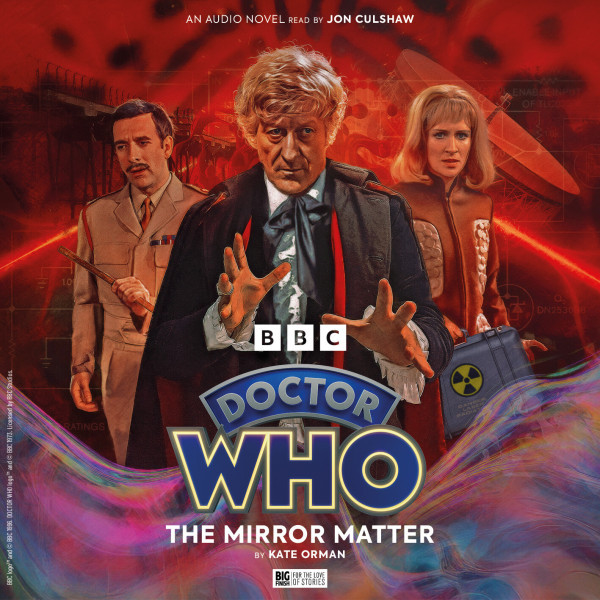
The Mirror Matter is a Doctor Who audio novel produced by Big Finish Productions and turns out to be not as riveting as I had hoped. It is written by Kate Orman and performed by Jon Culshaw.

Mirror Matter is a hypothetical counterpart to real matter, but this story proposes to inject some intelligence into the strange phenomenon.

This adventure takes place in the early days of the Third Doctor’s era where he is working with UNIT alongside Brigadier Lethbridge-Stewart and Liz Shaw not long after his exile by the Time Lord.

Strange spores have been detected, and the Doctor is able to identify it as Mirror Matter, which has been lurking on Earth for billions of years. He realizes that this Mirror Matter is not native to this planet, and the spores will change the nature of the planet and humanity on a fundamental level. There are also other human forces that want to take control of the Mirror Matter, but the Doctor knows that is not going to end well for anyone.

Culshaw, as usual, does a fantastic narration, which is enhanced by his impersonation of the late Jon Pertwee, who originally portrayed this version of the Doctor. Even if the story is a bit on the dull side, Culshaw seems to always help it make much more bearable with his enthusiasm and delivery of the prose.

The action depicted was a little hard to imagine at times. Also, I guess I had some trouble being interested in the concept of Mirror Matter, which is supposedly a real scientific idea.

Orman has been involved periodically with Doctor Who for years writing novels. She is an interesting writer, for the most part. There is nothing terrible about her writing style, but I just had a hard time staying interested in the plot.

I have plenty of memories of enjoying Orman’s previous works, and I expect that she will win me back.

As for Jon Culshaw, it is always great hear him coming through my speakers and this was no exception in spite of my other misgivings about this release.

I am still all for Big Finish, audio novels, and the Third Doctor. Hopefully, the next installment will be more engaging.

Doctor Who Audio Review: Hooklight Will Not Be Dimmed Easily

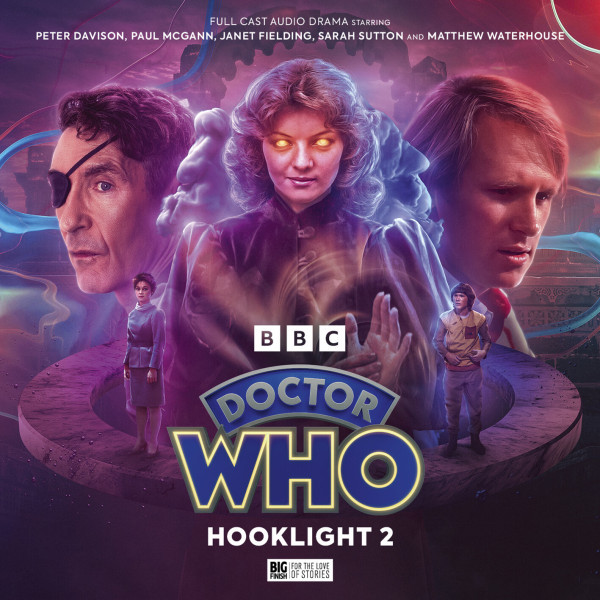
Doctor Who-Hooklight 2 brings a twelve-episode audio saga from Big Finish Productions to a most satisfying close. Tom Foley has done quite well with writing a very lengthy audio drama featuring the Fifth Doctor, played by Peter Davison. Janet Fielding, Matthew Waterhouse, and Sarah Sutton continue to bring formidable performances in their roles as Tegan, Adric, and Nyssa, respectively. Ken Bentley returns to the director’s position with his extensive experience with this company.

We also have Paul McGann in the mix as the Eighth Doctor, who is also using the moniker, the Oracle. Alan Cox, Kieren Bew, Shogo Miyakita, Celia Imrie, and Theo Solomon are included in the guest cast.

The force known as Hooklight is attempting to control Nyssa. The Doctor and his friends have been scattered throughout various planets and times. They have to make their way to something called the Dark Forge where they must face the Oracle. The Oracle knows the Doctor quite well, and their connection is much deeper than the Time Lord can anticipate. The Doctor has to find a way to free his friend from the influence of the Hooklight and reunite with his TARDIS. Of course, forces are aligned against the Time Lord, and it will take all of centuries of experience and cleverness to keep a certain light from being lit.

Foley used the extra time quite effectively to explore the main characters and the significant guest characters. We get to see how Tegan fares in a long-term relationship, which is quite interesting and even moving at times.

The appearance of the Eighth Doctor is also well-handled, and Foley sort of avoids some of the usual tropes whenever a story features more than one incarnation. Paul McGann is still compelling and has a perfect voice for audio performances. He is just an interesting actor all around.

I thought the Fifth Doctor was an interesting choice to create a huge saga around, but it works quite well. I also thought Waterhouse was particularly good at almost sounding as he did when he originally played Adric forty years ago.

Davison’s voice has aged and deepened noticeably, but I think he makes a good choice in not trying too hard to imitate his younger self. I still enjoyed his performance, and there was an interesting and poignant moment between the Doctor and Imrie’s Kessica Myles. The Doctor has figured out that Myles is terminally ill and offers to be there for her if she needed to grieve her situation. It was a moment of sensitivity from the Doctor that would often be absent from the television series. It was beautifully performed because the emotional significance was played with that famous British subtlety.

I: am usually rather leery of this superlong sagas in Doctor Who because there is some drag. Although there are some moments that it strikes me how long this thing is going on, I enjoyed this one very much.

Big Finish chose to release this in two parts. If more of these hefty stories are to be produced, I think I would prefer the whole story to be released at once. I hope that Foley is willing to do another one of that size because he really seems to rise to the challenge.

Hooklight as a whole is likely to be the best release of the year. There is still plenty of releases to be announced, but this one will likely remain in the top tier of my favorites for some time.

Doctor Who Audio Review: The Doctor Just Keeps Digging Up Danger

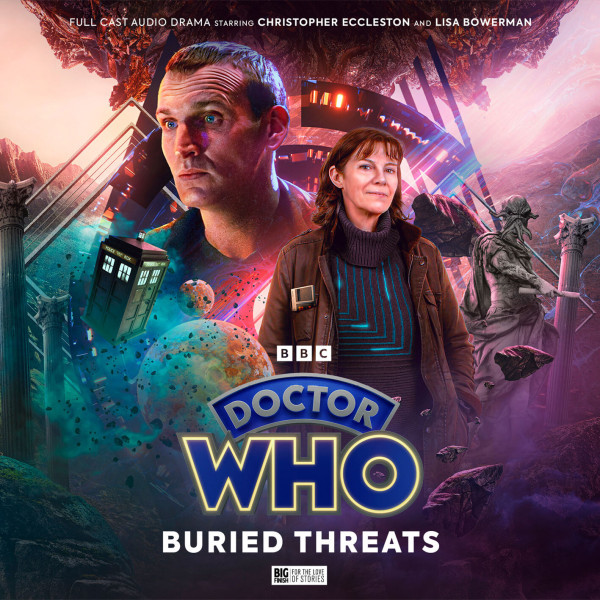
Buried Threats is one of the audio releases from Big Finish Productions that continues the Doctor Who range featuring the Ninth Doctor, played by the brilliant Christopher Eccleston. There are three episodes directed by Helen Goldwyn. Lisa Bowerman returns to the mic as Professor Bernice Summerfield, which is indeed welcome. The set is pretty good, but not much really stands out.

The first story by Lisa McMullen is entitled A Theatre of Cruelty. Alexander Vlahos takes on the role revolutionary artist and theatre director Antonin Artaud. Artaud is having dreams that are breaking into reality, and the Doctor suspects an alien influence as usual. The episode did introduce to me a new historical figure of which I was unaware. It had an interesting plot, but Eccleston has usual really elevates the story with his energetic performance as the Doctor. I enjoyed the episode, but I doubt I will remember much about it until I replay it.

The Running Men is the second entry written by Mark Wright and takes place in present-day Halifax in West Yorkshire. Fiona Wade is the main guest star alongside Eccleston. In this one, I learned about an infamous gibbet and an old legend about the spectral Running Men. In case anyone wants to know, a gibbet is like a gallows where people were executed long ago. A mysterious death brings the Doctor to the scene where historical tragedies are intruding on the present.

It’s also a good story where an uncommon legend is revealed to me. That helps me find some enjoyment and appreciation. It highlights a small piece of British culture and a town which apparently has some renown.

The performances are quite compelling here as is almost always case in a Big Finish release. Yet again, it’s an episode even with its interesting elements still doesn’t stand out as anything quite that unique.

Finally, Professor Bernice Summerfield encounters a new Doctor to her in Matt Fitton’s Ancient History. Benny is looking into a long-ago disappearance of a warrior race known as the Korravin. When she sees a battered blue police box, she knows an old friend is nearby and another danger is about to be unearthed.

This time, the Doctor has initially slipped in incognito with an alias. Benny doesn’t recognize him at first due to the Time Lord’s propensity for regeneration. When she does figure it out, she is not too pleased, but they get past that soon enough and work together like the old days.

This one is probably the stand-out of the set because of Bernice’s presence. Lisa Bowerman slips into the role with such ease, and the chemistry with Eccleston is quite evident. I think Benny actually pairs up well with any of the Doctor’s iterations. The moment of recognition is as deliciously volatile and funny as I hoped. There is even a little time for Fitton to tug the heartstrings a bit as Benny tries to figure out what the Doctor has been up to since they last met.

Overall, the set is enjoyable but is only really notable in that Bernice and the Ninth Doctor meet. The three writers are well-chosen for their reliability. Some of the more obscure elements of British history given a spotlight is pretty cool. Eccleston still has the chops to keep his Doctor compelling in all of his manic and often morose behaviors. This Doctor has survived the Time War and the terrible choices he had to make and live with.

This set of audio dramas may not be listed as one of the iconic releases by Big Finish, but it is once again not one that deserves to be ignored, and I am certainly up to more Ninth Doctor exploits.

Doctor Who Audio Review: The Destiny Of Mondas Revisited

Doctor Who: Genesis of the Cybermen is an audio drama from Big Finish Productions that revisits the origins of the Cybermen, a feat accomplished already in a previous release entitled Spare Parts. This story was originally conceived by Gerry Davis and adapted by David K. Barnes. Peter Davison returns yet again to the role of the Fifth Doctor and is accompanied by Janet Fielding as Tegan, Sarah Sutton as Nyssa, and Matthew Waterhouse as Adric. The director is David O’Mahoney. Nicholas Briggs again fires up the voice modulator to portray the Daleks. The remainder of the guest cast is comprised of Michael Abubakar, Nuhazet Diaz Cano, Kelly Price, Colin Tierney, and Evie Ward-Drummond.

The TARDIS has crashed on a world where a king is dying, and one of his sons is trying to save his civilization from a catastrophic shift in the planet’s orbit. The Doctor and his friends offer their help, but he soon realizes that he has arrived on the planet of Mondas at the birth of one of his greatest foes. The Cybermen are about to rise yet again and plan to survive by any means necessary.

This release is one in the range known as The Lost Stories. It was a script that was considered for the television series many moons ago and was ultimately scrapped.

Although this one isn’t bad, I still prefer Spare Parts. Genesis of the Cybermen is still worthy of a purchase and a listen though. The performances of the main cast members remain strong and distinctive. Davison still puts in a compelling performance even is he sounds noticeably older than he did forty years ago. The banter between the main cast is still compelling and amusing at times.

The guest cast is also well-chosen as is usually the case. Colin Tierney in particular has a complex role as the one who is fiercely loyal to this people and creates the Cybermen, one of the most horrific races in Doctor Who lore. It’s a suitably complicated story without going overboard. There are some interesting themes involving family and leadership explored.

The descriptions conveyed of the conversion process to become a Cybermen are as horrific as ever. Genesis of the Cybermen still does better than merely getting the job done as a source of entertainment. More Fifth Doctor is never a bad thing anyway.

Doctor Who Audio Review: Ghost Safaris And Stolen Memories

The range of Big Finish Doctor Who audio dramas featuring the Fourth Doctor continue with the latest satisfying release entitled The Hellwood Inheritance. Tom Baker and Louise Jameson reunite as the Doctor and Leela, respectively, for two stories contained in this set. Ken Bentley and Jamie Anderson share directing duties. Both stories turn out pretty well, but with Baker and Jameson in the lead, that’s going to be a likely outcome.

Alan Barnes starts off with a bit of spookiness in The Hellwood Inheritance. The guest cast includes Rosie Day, Chris Jarman, Richard James, James Meteyard, and Tamzin Outhwaite.

The Doctor and Leela arrive on the grounds of Hellwood Manor where they have a troubling encounter with a headless knight that pursues them through the grounds. After that escape, they meet the architects of what is planned to be a ghost safari and shown the “ghost catcher”. The Doctor is not sure that he is being told the whole truth about what powers the device, and a more sinister plot than a mere supernatural entertainment park is revealed.

I wouldn’t call this a real standout story, but it gets the job done as far as being entertaining. Tom Baker still sounds strong and engaged in the role even though he is close to his ninth decade at the time of recording. Jameson still slips into her most well-known character with ease.

I love a good ghost story in Doctor Who, and this fits the bill. There are not many scares or chilling moments, but the humor makes up for it. The performances are solid enough. The writing is not all that bad. Barnes has been associated with Big Finish and Doctor Who for some time, and his reliability as a writer remains evident here.

The episode still falls a little short of what I think would be among the more highly regarded stories in the range, but it still shouldn’t be overlooked. Tom Baker is well into his nineties here, so I am cherishing every new performance I can get.

The Memory Thieves is written by Phil Mulryne. The guest cast includes Daisy Ashford, Ayesha Antoine, and Wayne Forester.

The TARDIS arrives on a colony world in the future where strange pulses emanate from the forest, and the colonists lose their memories. The Doctor and Leela are separated by an earthquake. They have to earn the trust of the colonists in order to help them stop the force known as the Abeyance.

I had some trouble getting into this one. Baker and Jameson are still worth the time, but I didn’t find the story all that interesting. It’s not a terrible effort by Mulryne, but I did not find this particular contribution all that memorable.

It’s always fun to get some new stories with the Fourth Doctor and Leela, and this particular set was entertaining enough for me to still recommend to my fellow Whovians to give it a go.

Doctor Who Audio Review: The Early Days Of Exile

Doctor Who and the Brain Drain is a Doctor Who audio drama from Big Finish Productions with great performances but a bit too long of a running time for the plot. Nicholas Briggs serves as director and co-writer alongside Richard James while Tim Treloar returns as his version of the Third Doctor as originally played by the late Jon Pertwee. Daisy Ashford portrays Liz Shaw, who was originally performed by her mother, Caroline John. John Culshaw once again fills in for the late Nicholas Courtney as Brigadier Alastair Lethbridge-Stewart.

The talented guest cast is comprised of Mark Elstob, Susan Harrison, Rosalyn Lendor, Glen McReady, Callum Pardoe, and Milo Ratter.

This story begins soon after the Doctor is forced to regenerate by the Time Lords and sent to earth in exile where he joins forces with UNIT alongside his old friend, the Brigadier. He has yet to obtain his antique car he had named Bessie. The Master has yet to make his first appearance.

The Doctor, Liz and the Brigadier attend a symposium that introduces a new revolutionary treatment for memory loss and dementia, however there are also peculiar reports of sightings of mythical creatures around the site in Scotland. The Doctor suspects a malevolent alien influence at the heart of the mystery. The supposed miracle cure appears to be anything but. The Doctor disappears, and Liz and the Brigadier have to conduct their own investigations.

There seems to be an enemy who knows the Doctor, but he has yet to meet them.

This was an effort to recreate the seven-part episodes that were prevalent in the program’s seventh season which introduced the Third Doctor. The problem is that even in Doctor Who, those serials can feel a bit of a drag.

Treloar’s version of this Doctor is still quite compelling. Culshaw and Ashford also do well with their roles, which they have taken over from previous actors.

I also liked that the Doctor was absent for a couple of episodes, giving Liz and the Brigadier a chance to shine a bit as they proceed with their search for answers. I enjoyed how the Doctor re-entered the fray toward the climax of the story which seems to draw inspiration from The Hound of the Baskervilles when Sherlock Holmes is also left out of much of that story.

The story’s exploration of dementia is handled with some appropriate sensitivity in spite of the science fiction elements. It does demonstrate the heartache experienced by family members and caregivers of those afflicted effectively without slowing the pace of the story much. Other aspects slow the story down but not that.

There are some flaws that have more to do with the bloated length of the story, but it’s still pretty good. I just wish that Big Finish did more to represent the era without feeling like it needs to copy every aspect. I mean, it’s okay to have shorter stories.

This particular release is pretty good, but I don’t know that it’s the most shining example of the talent available to the company.

I don’t really like to quibble too much about a new Third Doctor adventure from Big Finish. This story is better than what the title would indicate. Pertwee’s era did have a few clunkers when it came to titles, but this is still a more than adequate release in many ways and certainly worth the time it takes for a listen.

Doctor Who Audio Review: A Carriage To Chaos

The Lord of Misrule is a Doctor Who audio novel from Big Finish Productions that is kind of an average story that is helped by a masterful narration and performance by the incomparable Jon Culshaw. Paul Morris is the writer and manages to craft a decent if unremarkable tale for the range.

The adventure features the Fourth Doctor, who would have been portrayed by the equally incomparable Tom Baker is this wasn’t an audio novel performed by Culshaw. It takes place starting off in 1901 and also features popular Victorian denizens Professor George Litefoot and Henry Gordon Jago. The Doctor is accompanied by Romana, as portrayed by the late Mary Tamm.

The story in London 1901 where the Doctor and Romana are visiting friends, Jago and Litefoot when they are made aware of people being taken off in a ghostly carriage. Other people with scattered memories appear in their place. It seems the carriage is ferrying people between the years of 1901 and 1801. When Romana and Litefoot are counted among the mystery, the Doctor and Jago pursue them and find themselves in a strange predicament with an alien influence at the heart of it. Also, an aristocrat wants to usher in an age of chaos and is wanting to be the one to choose the Lord of Misrule. The Doctor has his hands full with trying to find his missing friends, locate the alien influence that takes resides in the minds of unsuspecting humans, and trying to keep the fabric of society intact.

I usually don’t mind a lengthier Doctor Who story, but this one felt a little slower than usual. I also think that Jago and Litefoot run the risk of being overused by the writers.

The upside is Jon Culshaw is a masterful narrator. He has been doing impressions of Tom Baker for years and is the likely solution once Baker is no longer able to perform since he is now in his 90’s. He also really nailed the distinctive vocal range of the recently deceased Christopher Benjamin, who originally portrayed bombastic theater manager, Henry Gordon Jago. Unfortunately, he has a much harder time imitating Mary Tamm, but that is quite forgivable for obvious reasons. Culshaw’s enthusiasm for relating the story is infectious without feeling overacted.

The production of this release is first rate, but I had some trouble staying engaged with the actual story. It seems that Paul Morris has yet to be counted among one of my favorite Doctor Who contributors.

Still, it’s a release that doesn’t need to be ignored. I will likely revisit this one since it really isn’t a terrible effort. Culshaw’s performance really saves this one from a more pronounced rejection.

Doctor Who Audio Review: The Day Before D-Day

Operation Werewolf is a pretty decent Doctor Who audio drama from Big Finish Productions, but the story does feel a little longer than needed. This is an addition to The Lost Stories and would have featured the late Patrick Troughton as the Second Doctor if it was produced as considered during that era of the television series. His son, Michael Troughton, continues to fill in for his father alongside Frazer Hines and Wendy Padbury as Jamie McCrimmon and Zoe Herriot, respectfully. The script was written by Robert Kitts, who adapted the story idea from Douglas Camfield. David O’Mahoney serves as director of this play. The guest cast is pretty lengthy and includes Timothy Blore, Al Coppola, Stephanie Cornicard, and David O’Mahoney himself.

The Doctor, Jame, and Zoe arrive in Normandy just a few days before D-Day and soon find that the Germans are conducting experiments involving teleportation and brainwashing. I will go ahead and provide a spoiler in that there are no actual werewolves. Anyway, the Doctor gets separated from his companions and the TARDIS as usual. He once again has to protect the flow of history and avoid being a casualty of the Second World War.

The episode isn’t terrible, but I am having a hard time drumming up some real enthusiasm for it. It could be that the Doctor seems to spend a little too much time visiting the era of World War II, which feels annoyingly repetitive for a character who can travel anywhere in time and space.

As for the performances, everyone did fine. Michael Troughton does a pretty good version of his father’s role, but I still prefer Hines’ interpretation. I have quite an affection for this version of the Doctor, and it’s great that Michael has a regular gig to pay homage to his father.

Hines and Padbury still have that chemistry that have been charming and delighting audiences since the 1960’s. They obviously sound a little older, but it’s not too distracting. Hines can still pull off a convincing enough Scottish accent.

The writing is still pretty solid, but I just felt that six episodes not really justifiable for this particular story. Also, I think it would have been more interesting if werewolves were actually featured.

Operation Werewolf does have some elements that work pretty well, but it ultimately isn’t one I would consider all that special. I will say that more Second Doctor stories are still very welcome by this listener, and Michael Troughton can keep the gig as well.