Hot Property is the latest novel by Mike Lupica, which continues the Spenser series originally created by the late Robert B. Parker.
Spenser is hunkered down during a Boston snowstorm when he receives news that his friend, Rita Fiore, has been shot. Rita is a relentless flirt and one of Boston’s toughest attorneys. Her wound is not fatal, but Spenser is determined to find the assailant and bring him out of the shadows. Spenser learns of a pretty intense relationship with a politician that was ended abruptly when he inexplicably drowned. Rita believed her beau to be unimpeachable, but Spenser has some reason to be skeptical when a dodgy land deal seems to be at the heart of the matter. Unfortunately, another shooting happens, and this one is fatal. Someone is tying up some loose ends, and Spenser is very aware that Rita is likely still in danger.
It seems like almost everyone in Spenser’s circle has been shot throughout the series, including the private himself. The plot is actually pretty imaginative. Lupica does throw in some surprising twists. Some of the wisecracks seem a little recycled, but I often felt like that when reading Parker’s novels.
Lupica manages to emulate Parker’s style well enough to keep me engaged. It’s a standard caper for this series, but I wonder if Rita will make some changes in her rather reckless lifestyle in subsequent novels.
This is a pretty good contribution to the series, and Parker would likely approve this one. Lupica was a solid choice to continue the series, and I look forward to getting my hands on the next one.
Until then, my own literary indulgence continues with kind of a modern classic. I decided to read the beginning of what would become a major cinematic franchise by a highly regarded writer who is no longer with us. I am going to explore the wonder of Michael Crichton’s Jurassic Park.
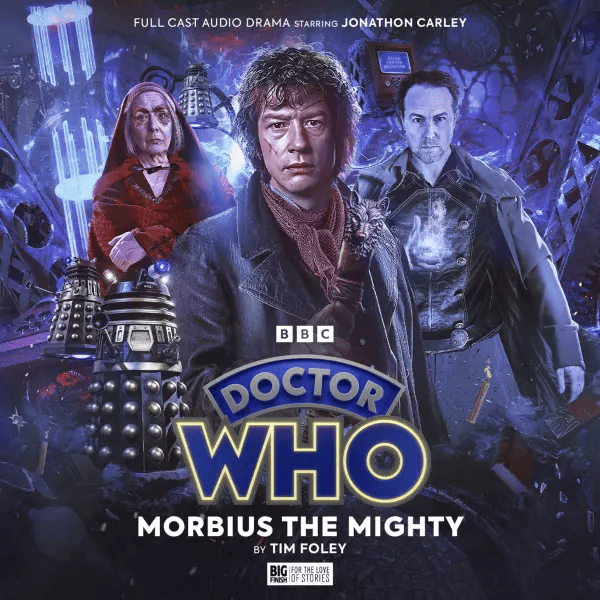
Morbius the Mighty is a recent Doctor Who audio play and adds to the increasingly compelling series, The War Doctor Rises presented by Big Finish Productions. Jonathon Carley continues his ever-improving impression of the late John Hurt as the War Doctor, that incarnation that was rejected by the other Doctors for his dramatic resolution of the Time War. Tim Foley is the script writer while Bethany Weimers serves as director.
The guest cast is comprised of Samuel West, returning as his version of the tyrannical Time Lord, Morbius, alongside Sheila Ruskin, Gareth Armstrong, Theo Solomon, and Pamela Novete. Nicholas Briggs also returns to the sound booth voicing the Daleks.
The War Doctor has been poisoned with a substance that keeps him from being able to travel in time. He is in seclusion on a rather peaceful planet and is tended to by a nurse named Cora, formerly of the Sisterhood of Karn. The Time War continues to disrupt the cosmos, but the War Doctor has been able to find one of the few sanctuaries that have yet to be affected. In the meantime, an ancient evil has been resurrected, and Morbius has a consuming grudge against the Doctor. The War Doctor is compelled to re-enter the fight, and not even Morbius may be ready for what his old enemy has become in order to battle more effectively.
Foley is becoming a pretty consistently interesting contributor to the series. He does indulge in a rather shameless ripoff of Star Trek II: The Wrath of Khan that I found a little distracting, but he later owns that in the exclusive interviews, so I wasn’t quite so annoyed.
West has a great interpretation of Morbius. He has played the role before for Big Finish and really brings out this silky, charismatic menace that is quite a treat to listen to. Morbius has a companion of his own in the shape of a Time Lord known as Judd, played by Gareth Armstrong. Armstrong is a great addition to the cast as well.’
The relationship between the War Doctor and Cora is quite interesting as well. There is kind of a prickly affection between the two of them, which is a familiar dynamic in the series, but Foley uses that trope quite effectively here.
Carley continues to display immense talent in his efforts to flesh out this conflicted and at times ruthless version of the Doctor. The War Doctor still has characteristics of his other selves, but he is the one better suited to fight in a cosmic conflict of this magnitude. He is certainly the one best able to stand against Morbius.
The action sequences will likely take some re-listening to get a better sense of what is going on. The final faceoff between the War Doctor and Morbius also pays off. In a strange way, there is something inspiring about the War Doctor’s willingness to get back into the fight in spite of his condition. He also throws out some typically mocking barba at Morbius that make me enjoy this chracter more.
Anyway, it’s a strong addition to the series. The post-production work continues to be done with stellar attention.
Morbius the Mighty is likely to be considered one of my favorites in recent years.
Hit Man is a rather slow-paced but interesting novel by Lawrence Block which introduces his professional killer known as Keller.
Keller is a cool, efficient professional killer who seems to be going through something of a mid-life crisis. A young woman who is initially hired take care of his dogs as he travels to various locales for his rather unusual and lethal occupation. He seems to find himself on a path that almost leads him to a more normal life, however he has to contend with an employer and benefactor who seems to be making reckless decisions that leads to Keller making a tragic mistake during one of his contract jobs.
The novel is well-written, but it seems a little disjointed at times. I looked into the origins of this character and learned that this book was a re-working of several short stories that was combined into one volume. Apparently, Keller was first published in the pages of Playboy several years ago. That helped me make more sense of what I was reading.
I did find this novel pretty good even if the idea humanizing a hitman is a somewhat overdone story idea.
Block has been in the game for some time, and his status of a highly regarded crime writer is well-earned. Even if the structure of this story struck me as a little unusual, I did enjoy the ride once I learned how Keller was first debuted.
Block does put in quite a bit of exposition, which understandable since Keller is not exactly a chatty sort. The prose is still pretty tight and flows quite easily. The actual murders are depicted quite crisply and can be easily missed at times.
Anyway, this novel is worth a look by any aficionado of crime fiction. Lawrence Block has quite a gallery of memorable protagonists, and it was a treat to be introduced to Keller in all of his deadliness.
Well, the great Robert B. Parker may be gone, but Boston PI Spenser is still on the streets with the help of Mike Lupica which brings up my next read. A close friend of Spenser’s is shot, and that’s just not going to fly with Boston’s venerable private eye in Hot Property.
Doctor Who: Fixers brings another trilogy of adventures featuring the Seventh Doctor from Big Finish Productions, and he has an interesting new companion for this round. Sylvester McCoy is joined by Sara Griffiths, reprising her role as Ray, who was first introduced many years ago in the television serial, Delta and the Bannermen. This set is brought to us under the direction of Samuel Clemens.
The guest cast is comprised of Rhian Crowley-Mclean, Celia Imrie, Poppy Miller, Anne Odeke, Marc Silk, Sion Tudor Owen, and Annie Wallace.
Chris Chapman is first up to the plate with his script entitled The Executor. The Doctor receives word of the death of Time Lady known as Peg and is tasked with taking responsibility for her TARDIS. The Doctor and Ray find that there is something else aboard, and he has to call upon her hologram to lend assistance.
This is a strong start to the set. Imrie’s portrayal of Peg is quite engaging, and she sparks off McCoy’s performance quite effectively. I was a little unsure of how much I would enjoy bringing Ray aboard the TARDIS, but my doubts were quickly assuaged. Griffiths brings a more mature version of the character than was seen in the television serial, and it works.
This is a pretty intriguing story because it does add another layer to the Doctor’s history without a lot of explanation as to what the nature of the relationship between him and this new, now deceased Time Lady.
Oil and Water, written by James McDermott, is the almost obligatory plotline warning us all about the dangers of pollution. In this case, mutated seals are killing people, and it seems that some sentient well of oil is at the heart of the tragedy. The Doctor and Ray have to contend with a grieving woman who is hungry for vengeance. Also, it seems that seals are not the only ones possessed by this unique presence.’
It’s an interesting idea, but the growing friendship between the Doctor and Ray carries it through more than the actual story. I found it to be once again a little too politically heavy-handed, but it’s not the first time that Doctor Who has almost bludgeoned the audience with this topic.
McCoy and Griffiths still make this worth the time as well as the other performances. It just isn’t going on the list of favorites for this listener.
Finally, Much Ado About Racing by Fio Tretheway, finishes up this set with the Doctor and Ray coming across some kind of galactic race between two women who are apparently bitter rivals but with a more complicated history. Ray is hearing a voice in her head that is bringing old regrets from her past. The Doctor finds there is another entity at work feeding on others’ sorrow.
It was a better episode than the second one but not as strong as the first.
The set started off pretty strong, but the remaining two stories didn’t quite hold my interest as well as the first episode. Still, the performances make this work, and I like Ray travelling with the Doctor for this collection. She is not done yet apparently.
Overall, it’s an enjoyable addition to the Big Finish catalog. None of the stories need to be ignored entirely. I think a couple of them could use a bit of fixing, but the set still functions pretty well as a whole.
In the meantime, I will wait for the next installment with the Doctor and Ray together at the TARDIS console. This should be a fun journey as it usually is when it comes to Doctor Who.
A People’s History of the United States by Howard Zinn doesn’t come across as an unbiased view of the illustrious existence of the likely most influential nation on this planet. To be fair, no one can likely achieve the state of complete objectivity, so I don’t hold anything against Zinn, although I would likely disagree with many of his conclusions and opinions if we had ever been able to meet.
Zinn’s objective is to highlight the policies and decisions that the federal government enacted over the relatively few centuries it existed that impacted the common citizen the most. He hits the highlights and lowlights of this country pretty thoroughly and does come off as quite critical of his own country. That is his right, and I applaud him for presenting a book that I found to be pretty well-written. I do not normally read history books on my own, so I do not have much of a comparison to make to other works of this kind at this time.’
I do applaud Zinn for acknowledging his biases in the afterword, so I can respect him as a writer even though I suspect that there are perspectives that may have been overlooked in this particular work. There again, one can likely make a credible case for that in just about every book of this genre.
This is a well-known presentation of the country’s history and was referenced in at least one popular movie that I know of.
Anyway, Zinn seems to have been quite diligent in his research and throws quite a bit at the reader. It’s a tough read for someone just indulging their curiosity, but I still enjoyed making the effort. I am not sure how much I will be able to retain, however it still seems worth the time,
This book comes with a reputation, and it seems to be derided by many of those on the conservative side of the political spectrum. Those criticisms likely have some validity, but I would still recommend adding this to the reading queue.
I am returning to a more familiar genre in my next read with Last Voyage by British mystery writer, Anna Clarke.
Doctor Who: The Haunted Windmill is an audio boxset from Big Finish Productions which has the Second Doctor, played by Michael Troughton, escape into an alternative reality where his various interventions in Earth’s troubles never happened. There are three episodes all written by Alan Barnes and directed by Nicholas Briggs.
Troughton continues his efforts to channel the spirit of his late father, Patrick Troughton, and bring a fairly impressive vocal performance that at times almost matches the elder’s. Anyway, I really like the Second Doctor, and Barnes is a reliable writer who once again delivers a solid contribution to the lore.
Fraser Hines returns to the mic as Jamie McCrimmon and a descendent of his, who is revealed. Wendy Padbury is also on deck, returning as Zoe Herriot. Other familiar characters from the Doctor’s past also gather around him in spite of the unfamiliar circumstances.
Also, this TARDIS team has picked up another companion in the form of the Time Lady, known as Raven, who is portrayed by Emma Noakes. Raven has been a presence for a little while in the Second Doctor Adventures, and she has been growing on me.
To be clear, this is a period after the Doctor was sentenced to exile in The War Games but before that sentence was actually carried out. He has yet to regenerate into his third incarnation. He has been reunited with Jamie and Zoe who are now older in this range.
Anyway, Alan Barnes usually comes through with some entertaining and pulls it off yet again.
The Haunted Windmill starts off with the Doctor, Jamie, Zoe, and Raven don’t want to be dragged back to Gallifrey, so they make their escape into a parallel universe and arrive on Earth in 1963, which is not entirely identical to what the Doctor remembers. After Jamie and Zoe suddenly vanish, the Doctor and Raven find an abandoned windmill where they must set up shop to repair the TARDIS. Detective Inspector Lethbridge-Steward, played by Jon Culshaw, is investigating a series of strange thefts. A ghost has been sighted on the marsh. A pair of youngsters are drawn into the Doctor’s presence. This reality may not be what the Doctor remembers, but dangerous adversaries are starting to find their way to him.
It’s not a bad start because the chemistry between the Doctor and Raven is really starting to develop with Jamie and Zoe sidelined. Although Padbury and Hines are still around as a part of their lineages, and it works well. In effect, the Doctor gains two new companions in the shape of Bertie and Lucius, played by Olivia Woolhouse and Ilan Galkoff, respectively.
Besides, who can fail to be intrigued by a haunted windmill?
The Crystal Ship is the second story and probably isn’t going to count as a favorite, but it’s a fine addition. Daisy Ashford makes an appearance as Liz Shaw, a role originally brought to life by her mother, Caroline John. The Doctor finds that an experimental rocket plane has been taken over by some familiar adversaries, but they have not encou8ntered him before in this altered reality.
There are some fun performances here. Roger Ringrose seems to really get into his role as the obnoxious Professor Quigley. I thought bringing Liz Shaw in was a bold decision, but it does work pretty well.
Michael Troughton continues to improve in his performance. He says that he is not trying to a carbon copy of his father’s performance in interviews and believes that his father would approve of his efforts to leave something of himself on the performance. He is probably right, so I try not to be too critical of his participation. What is more important is that Michael doesn’t manage to wreck the nostalgia and still keep his version of this Doctor familiar. He is accomplishing that much.
Anyway, I am not sure this is Barnes’ best effort, but it gets the job done and manages to keep me pretty close to the right amount of suspense.
Finally, this set comes to an end with The Hungry Glass in which the Doctor and Raven come across a peculiar mirror which contains something more than reflections. Another old friend is trapped behind the glass, and very familiar old enemies are also lurking. The Doctor’s past is converging on him even more, and his future becomes even more in doubt.
Overall, I did enjoy this set and the efforts to scramble the canon just enough to keep things interesting without tossing the whole history into the trash can.
Alan Banes was a great choice to continue this range. I am not one of those fans intrigued too much by the mythical season 6b, but Barnes does a good job playing with some of those concepts. Of course, I am willing to give a lot of leeway which it comes to the Second Doctor.
Nowhere to Run by C.J. Box is another solid installment in a pretty compelling series featuring game warden Joe Pickett.
Joe Pickett is wrapping up a temporary assignment in Baggs, Wyoming before returning home to his wife and daughters. He gets reports of some harassment of campers and an elk that was illegally butchered. Pickett looks into the matter and encounters a pair known as the Grim Brothers. When an attempted arrest goes very wrong, Pickett barely escapes with his life. There also seems to be a peculiar connection to an aspiring Olympic runner who had vanished a couple of years earlier. Pickett’s word comes into question when subsequent investigators can find no evidence of his harrowing ordeal with the Grim Brothers. Pickett has to decide if he needs to return to the mountain for the sake of justice and his peace of mind.
Box kind of flirts with the supernatural here when the legend of Wendigos is mentioned. A wendigo is a legendary evil spirit that can resemble a human that may eat human flesh.
Box does a pretty good job of threading together a pretty diverse set of unusual circumstances. Pickett also deals with the challenges of being a father of growing daughters, including a traumatized and sullen foster daughter. The devotion he has for his wife and daughters is rather moving and inspiring.
Pickett is a flawed yet unquestionably noble protagonist and is too often accused of being stubborn. It is an admirable stubbornness, however.
Box continues to be a competent writer and storyteller. He has a pretty good pace when it comes to letting the story unfold.
This novel does get better as more secretes are revealed. There is nothing too extraordinary about this particular installment in the series, but Box does a good job of keeping the reader’s attention.
I have decided to take a different literary path for the time being. The next read is Howard Zinn’s A People’s History of the United States.
Snare is a Doctor Who audio drama from Big Finish Productions which reunites the dream team of Christopher Eccleston and Billie Piper. Tim Foley is the writer with Henel Goldwyn directing once again. Camille Coduri returns as Jackie Tyler with Alex Austin and Hannah Brown rounding out the guest cast.
The Doctor and Rose Tyler have returned to the Powell Estate to take a brief rest from their recent adventures. A childhood friend of Rose’s has also returned after his father recently died. Kevin finds that his father had some otherworldly secrets tucked away, and the Doctor identifies a most unusual trap sprung by a hidden extraterrestrial vessel. Kevin’s father was known to have some mental issues, but something else seems to have been tormenting him. The Doctor finds that a brief rest is just not likely to be in the cards for him.
Foley delivers a good one here, and Eccleston and Piper slip into their best-known roles with ease. Coduri is also on her A game with her performance as well.’
The story does weave pretty easily between action and something a little more emotionally relatable. Foley offers a pretty compelling depiction of a complicated father-son relationship in a short time without compromising the main plot.
This episode is apparently kind of early in the Doctor and Rose’s relationship as well, and they are fresh off the heart-wrenching events of Father’s Day.
The Doctor is also at his most vulnerable due to the consequences of the Time War, and the decisions he had to make during that ordeal.
The episode has a sort of Jumanji vibe without directly stealing from it. There is no weird boardgame, but a strange wilderness seems to have merged with a flat.
Anyway, this episode gives a promising start to a new and unexpected range, and I have little reason to complain about more episodes featuring the pair that kicked off the television revival in 2005.
The Skin Collector is a thriller written by the prolific and popular Jeffery Deaver and features the quadriplegic criminalist, Lincoln Rhyme. The audiobook is read by Edoardo Ballerini.
This time, Rhyme and his partner, Amelia Sachs, have a couple of investigations going. While Rhyme is somewhat morose over the death of a very worthy and dangerous adversary, another killer is on the loose. This particular unsub likes to tattoo his victims with a good dose of poison mixed into the ink. There seems to be a connection to another killer known as the Bone Collector, the case that brought Rhyme and Sachs together. As Rhyme and his team dig a little deeper, there seems to be a more complicated motive than just some depraved lunatic getting his kicks. In fact, a more lethal conspiracy seems to be in the making, and Rhyme and Sachs find that this killer may have infiltrated their haven and targeting those clostest to them.
Ballerini does a decent job presenting this story, but it’s not a plot that I found all that memorable. There were too many callbacks to previous cases. I confess that I have not read many books in this series, so I was a little handicapped when it came to recalling or understanding everything that led to this particular novel.
Deaver seems to be a little overly fond of providing somewhat outlandish monikers to his killers. Rhyme starts off this one reflecting over his mental duels with someone known as the Watchmaker, who had recently been reported deceased.
Anyway, Rhyme is just brilliant and curmudgeonly enough to stay interesting overall. Deavber had some pretty good and macabre twists. He is another writer where I can understand why he is such a following, but I doubt that I will be a consistent fan. I may not return to his works in a hurry, but I will likely find my way back to his catalog eventually.
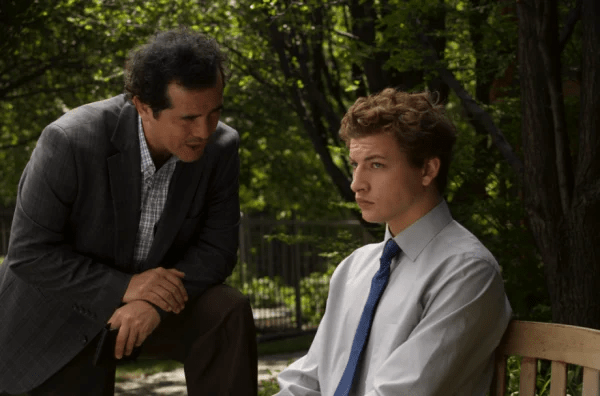
The Night Clerk is an almost painfully mediocre suspense film written and directed by Micchael Cristofer about a motel clerk with Asperger’s Syndrome who sets up cameras in rooms to spy on guests so he can learn how to imitate their mannerisms. He apparently believes this will help him be less socially awkward.
Tye Sheridan is in the lead as Bart Bromley with Ana de Armas, John Leguizamo, Helen Hunt, and Johnathan Schaech included in the pretty small cast.
Bart finds that he is the lead suspect when a pretty lady is found dead in the motel room with him in the vicinity. He is assigned by a sympathetic boss to another location where he meets another pretty lady who flirts with him and reveals that she is in an affair with a married man. The detective, played by Leguizamo, continues to hound the hapless Bart while the real killer is desperate to cover his tracks.
This is a bit of a knock-off of Alfred Hitchcock’s Rear Window, which isn’t a bad source for inspiration even if it has been overcooked over the years. The cast is solid enough with convincing performances; however, it just feels so slow. There are no real surprises. Bart does come off as a bit creepy at times, so I found it hard to maintain any real sympathy for him. An actress of Helen Hunt’s caliber feels wasted in the role as Bart’s protective mother. There are also times where it feels that the killer takes a somewhat more convoluted approach than necessary to keep his secret. I can go on and on, but I have a full plate today.
The bright spots in this film were there but seemed a little muted at times. Overall, I think audiences have seen this kind of setup too many times, and Cristofer really doesn’t offer up much in the way of an interesting or unique twist. I didn’t really care much about the protagonist in spite of him being inflicted with a very challenging condition. Sheridan does do a solid job in his portrayal, but that wasn’t enough for me to muster up any real appreciation for the film as a whole.