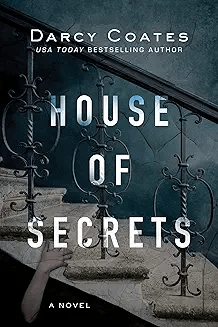
House of Secrets by Darcy Coates continues to bizarre first weeks of a rather unconventional marriage between Sophie and Joseph Argenton, who had just apparently defeated an ancient, evil entity known as the Grimlock.
The couple learned that their victory is not complete because the Grimlock has now possessed Joseph’s young cousin, who was taken by her father to another isolated estate where there is hope that a remedy can be found there. The mansion known as Kensington has its own secrets related to the Grimlock. Joseph finds that his family curse is not shaken so easily as he realizes that his own body and spirit are breaking down. A ghost with unclear motives is also stalking the corridors of Kensington, and Sophie is drawn into the puzzle as to whether this spirit is allied with Grimlock or has another agenda altogether,
This horror novel has some interesting moments, but it is not that memorable. Coates is a competent writer, and I was rather interested in seeing how the story turns out, so the job was done well enough.
The impression left on me was rather shallow, but it’s still not a bad piece of horror fiction. It was compelling enough for me to be interested in how the story wrapped up, so Coates’ efforts were not in vain.
Next up will be one of few journeys into non-fiction as I delve into Tom Clavin’s Dodge City: Wyatt Earp, Bat Masterson, and the Wickedest Town in the American West.
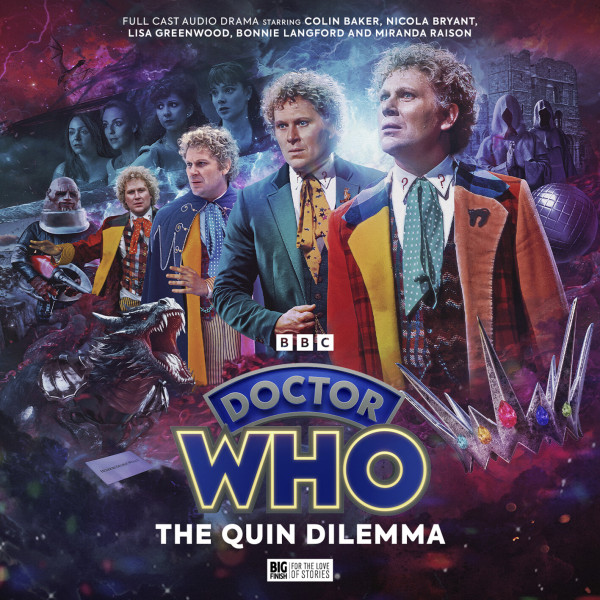
Big Finish Productions releases an enjoyable Doctor Who audio boxset celebrating forty years of Colin Baker as the Doctor’s sixth incarnation. The Quin Dilemma contains six interlinked stories written by three authors and directed by Samuel Clemens. Bonnie Langford and Nicola Bryant reprise their roles of Melanie Bush and Peri, respectively. Miranda Raison and Lisa Greenwood return as Constance Clarke and Flip Ramon, a pair of companions created by Big Finish. Phil Labey accompanies the Doctor as a certain Herbert George Wells in one of the stories.
The Exaltation by Jacquelin Raynor kicks off the set and has the Doctor and Mel on the planet Arunopel where the Time Lord is checking out a temporal anomaly. The king is about to step down, but he is uncertain as to which of his five sons is going to inherit the throne. The king believes the Doctor responsible for the disappearance of his wife many years ago and sets his sons out to find him in various points in his timeline.
Chris Chapman picks up the story with Escape from Holy Island where the Doctor, Peri, and a young HG Wells are visiting an island in the year 739 on the eve of a Viking invasion, however the raiders that are coming may be something else.
It’s a pretty good continuation, and the idea of HG Wells being in the TARDIS beyond the one television adventure Timelash is a fun if rather predictable idea.
Robert Valentine brings in a two-part story featuring the Doctor now traveling with Mrs. Clarke and Flip Ramon on a planet in the midst of a civil war, and Sontarans interfering. Sibling Rivalry and Children of the Revolution are the titles of these two episodes. Also, the Doctor has to contend with potential kidnappers in the shape of two of the quintuplet princes on the hunt for him.
Chris Chapman returns to the story roster with The Thousand Year Thaw in which the Doctor and Peri encounter another of the Quin princes, a pleasant walk turns into another familiar fight for survival.’
This story is pretty notable because there is a very charming and enlightening scene in which the Doctor and Peri reflect on their friendship and recall the Doctor’s rather manic reaction to his regeneration. I always thought this Doctor’s introduction was one of the clumsiest introductions in the series. In The Twin Dilemma, the Doctor nearly throttles Peri to death in a fit of mania induced by the trauma of his transformation. Chapman comes up with a pretty plausible explanation as to why Peri decided to continue her travels with the Doctor after that horrendous episode. It was a great scene, and Baker and Bryant perform it masterfully.
Finally, we get the amusing pleasure of watching several versions of the Sixth Doctor interact with each other in Rayner’s The Firstborn. The various companions also meet up to find the answers to this potential paradoxical catastrophe.
Somehow the idea of four different versions of the same Doctor meeting up seems like it wouldn’t work on audio, but it comes off pretty well without as much expected confusion. Colin Baker sounds fantastic throughout this set.
Some stories are a little better than others, and I was rather pleased that some of the seemingly inexplicable choices that Peri made in the television series were addressed.
Jonnie Broadbent is the actor portraying the Quin brothers and does a pretty good job at vocally differentiating between the characters.
I have had mixed feelings about the Sixth Doctor before Big Finish rehabilitated him with much better writing that fleshed out the more appealing sides of his personality. Although much of his familiar brashness was kept, he also displayed far more moments of compassion and cleverness than in the television series.
There is a bit of muddling in the plot, but the performances and intended celebration of this Doctor makes it tolerable. Besides, Doctor Who is a bit of a muddle anyway.
The Quin Dilemma is a set that shouldn’t be passed over. May Colin still have many more years with Big Finish as well.
Free Fire by C.J. Box continues the compelling saga of now former game warden Joe Pickett and his family as he is given another chance to regain his job when he accepts a confidential assignment from the governor that takes him to Yellowstone National Park.
Pickett had been dismissed from his game warden position in the previous novel and starts off this one working as a ranch hand for his mother-in-law’s new husband. A case has broken when a murderous lawyer slays four people in a corner of Yellowstone National Park that is some kind of legal free fire zone. There may not be a way to prosecute this attorney, but Pickett is tasked with uncovering a motive. When some of his new colleagues are attacked or killed, Pickett starts to understand that there are some secrets that threaten many people, and some of those are willing to add him to the body count.
Box hits on an interesting idea that one can lure his intended victims to some zone where the normal laws prohibiting murder don’t apply as they would in anywhere else in the country.
Anyway, I found the novel enjoyable, but I am likely a pretty consistent C.J. Box reader. There isn’t much that’s groundbreaking, but it remains interesting. Pickett and his family remain compelling because they try so hard to be conventional and normal in many ways, but they keep getting thrust into dangerous situations because of his career.
It’s a pretty enjoyable and interesting entry into the series, but it’s not quite a homerun.
Next up, I am returning to the realm of the supernatural with House of Secrets by Darcy Coates.
The Bad Weather Friend is one of Dean Koontz’s more bizarre additions to his bibliography, but it’s pretty entertaining and not without some creativity.
An amiable realtor named Benny Catspaw suddenly has his life come apart at the seams when he loses his job inexplicably. Even more troubling is when his fiancée ends their relationship. As Benny is trying to understand this onslaught of misfortune, he suddenly receives an unexpected message from a man claiming to be a previously unknown uncle. A crate is delivered which Benny later finds contains a giant of a man called Spike who says that he is a being who is assigned to people who are apparently too nice for this world. Benny also meets a waitress who is an aspiring private eye, and she is an enthusiastic ally. During the present-day adventure, Benny recalls his peculiar family history and his time at an unusual boarding school where he did have a couple of friends. Benny finds that he has been targeted by a powerful group, but he has a rather interesting being known as a craggle working on his behalf as well. Spike is sworn to keep Benny from the worst the world is able to throw at him and will employ some unusual and fantastic tactics to do just that.
Koontz remains an imaginative and witty author. This story is rather strange but pretty entertaining. Koontz is pretty skilled at the art of witty banter. The protagonists are likeable enough. Spike is a rather unique creation, but the story sort of loses some sense of suspense because he is pretty invulnerable.
The themes in this novel are little too familiar in Koontz’s works. Once again, it is someone with an ideal sense of morals and outlook on life. The villains that are revealed are a little too cartoonishly narcissistic to be really believable, but I suppose such people do exist. Koontz also is back into the realm of strange conspiracies and shadow organizations, which feels annoyingly repetitive.
Koontz does have a distinctive turn of phrase which keeps the story compelling. There are some pretty amusing passages throughout the novel.
Koontz does seem to be a literary one-trick pony sometimes, but this novel still is worth the time. I read a lot of Koontz in my younger years, and I don’t regret revisiting his prose this time in spite of mixed reactions to this particular novel.
The lifelong reading binge continues with C.J. Box’s Free Fire.
The Four Doctors is a Doctor Who audio drama from Big Finish Productions and is a pretty decent multi-Doctor episode, although there have been better. It is written by Peter Anghelides and directed by Nicholas Briggs and Ken Bentley. Peter Davison, Colin Baker, Sylvester McCoy, and Paul McGann all star as the Doctor. Nicholas Briggs also returns to voice the Daleks. The other members of the guest cast are David Bamber, Ellie Burrow, Nogel Lambert, andAlex Mallinson.
There is a vault with a dangerous secret, and the Fifth Doctor has discovered something called temporal leakage at this station run by biomechanoids known as the Jariden. A Dalek attack force is on the way, and a Jariden finds himself swept up in the Doctor’s timeline where he encounters several different versions of the Time Lord.
There are some interesting directions this story takes that differ from other multi-Doctor stories. The Doctors don’t really spend much time together other than kind of a tacked on final scene, which I am sorry to give that much of a spoiler. Most of the story deals with this Jariden military officer who is accompanied by a wrecked Special Weapons Dalek and pursued by the Dalek Prime. He encounters the Doctor in different incarnations as he gets swept up by some breaches in Time.
The main plot idea is solid enough, and the performances are more than acceptable. I guess I was a little let down that Anghelides felt the need to have the Doctors interact with each other without actually working together to solve a crisis. I just believe that one must have a multi-Doctor adventure, let him argue with himself and deal with the threat. If Anghelides wanted to have the Doctor work on some piece of the problem from various points in his timeline, that would be just fine because it would be something not really experienced by the audience all that much.
Doctor Who has a lot of silliness imbedded into its DNA anyway, but generally the multi-Doctor episodes tended to stretch that absurdity to the limit. They just are not usually written that well. Big Finish does do a better job with this type of episode than the television series could manage
Still, most of the major elements in this episode work quite well. Even if I feel the Daleks are a little overused, I didn’t mind their appearance here. The Doctors were still great. The main story had some creativity, and there were even a few profound moments that were kind of moving.
Even if I would have preferred a different final scene, it’s still an enjoyable episode on the whole.
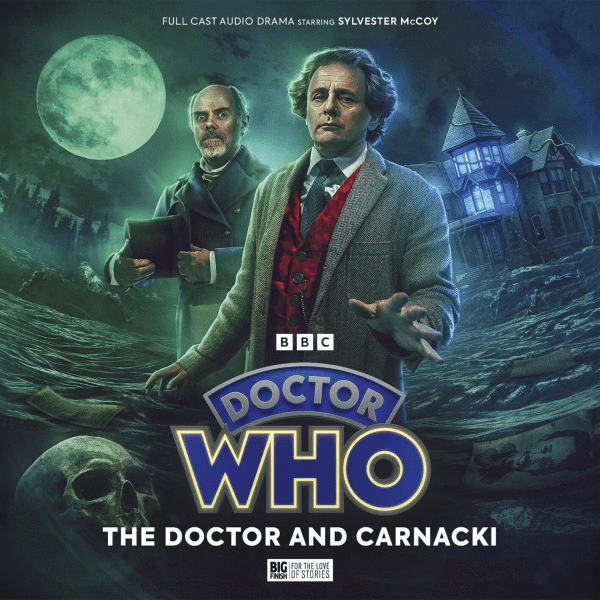
The Seventh Doctor shares a trilogy of audio adventures with an investigator of the supernatural known as Thomas Carnacki in the set entitled Doctor Who: The Doctor and Carnacki. Sylvester McCoy makes a welcome return to Big Finish Productions studio in a trio of macabre episodes. Joe Jameson and Dan Starkey share the role of Carnacki, who is presented in various stages of his lifetime. Samuel Clemens.is the director of this release.
Thomas Carnacki is the fictional creation of William Hope Hodgson, who was killed in 1918 during World War I. Carnacki is probably better known among the more dedicated readers of supernatural fiction. As mentioned before, there are three stories to discuss, so I will get on with it.
The Haunter of the Shore by AK Benedict starts this series off. Joe Jameson plays the younger version of Carnacki with Caitlin Joseph and Shogo Miyakita also lending their vocal talents.
Carnacki is called in to investigate the appearance of skeletons on a lakeshore near an estate inhabited by a recent widow and possibly strange spirits lurking in the shadows. A hermit is also discovered. He has a distinctive Scottish accent and surprising ideas about Time and where the spirits may originate. The Doctor and Carnacki meet for the first time.
Benedict gives the listener a pretty good start to this collection. McCoy still sounds great. Age has had little effect on McCoy’s vocal abilities and performance so far. It’s a pretty solid haunted house story; however, the Doctor discovers a more extraterrestrial origin to the troubles. There’s nothing too spectacular in this one, but it’s pretty good. The performances hold up, and now that I have read up a little on Carnacki, it’s a pretty good idea to have the Time Lord meet this guy.
The House by Georgia Cook has a rather unimaginative title, but the story itself is quite a bit better that it would suggest. Harry Hart plays a friend of Carnacki’s named Arkwright, who is haunted by a house in a most unusual way. His affliction goes back to his and Carnacki’s childhood, and the Doctor has arrived to help find the answers.
Starkey has taken over the role as an older Carnacki and is just as solid a performer as ever. It’s a unique take on a haunted house story since Arkwright is becoming the house or something.
Anyway, it’s a pretty good contribution to the set
Finally, Jonathan Barnes concludes this set with The Institute of Lost Souls. Rebecca Crinnion, Ewan Thomson, and Alan Cox are included in the guest cast with Dan Starkey continuing on as Carnacki.
Carnacki has a story to tell about a refuge for wounded soldiers that comes under attack by strange and savage creatures. The Doctor arrives again, but he is burdened with a terrible secret regarding Canacki’s fate.
The collection is quite enjoyable, largely because I appreciate a good ghost story even if there is an alien malevolence involved. Starkey is always a treat when he performs. He also is a compelling narrator. The last story is framed with a scene of Carnacki recounting his latest encounter with the Doctor to a group of close friends, which apparently was a common literary device used by Hodgson.
There is some real imagination at work in all three of the writers. McCoy remains in top form as the Doctor. The sound effects are great.
I appreciated the introduction to a fictional character of whom I know so little. The Seventh Doctor is a good foil for Carnacki, but I suspect I would have enjoyed it regardless of the Doctor’s incarnation.
Anyway, it’s a fun addition to the series and worth the time to sit back and listen.
Gladiator II is one of the rare sequels that deserves about as much acclaim and affection as its predecessor receives from movie fans. Ridley Scott returns to the director’s seat with a script written by David Scarpa. Scarpa shares story credit with Peter Craig.
Paul Mescal plays the lead role of a captured warrior named Hanno; however, he has another identity which is revealed in due course. Pedro Pascal, Connie Nielson, Denzel Wahington, Derek Jacobi, and Matt Lucas are included in the lengthy call sheet.
This story begins about sixteen years after the events depicted in the first film in which celebrated gladiator Maximus Decimus Meridius had died at the end. Rome is being ruled by a couple of twin emperors who really indulge themselves in the power of their position. Hanno is living in Africa with his wife when Roman soldiers conquer the town, kill his wife, and take him prisoner. Hanno survives and prevails in an unexpected display of combat against some feral baboons and is bought by a gladiator promoter named by Macrinus, played by the always formidable Denzel Washington. Hanno starts winning tournaments but is recognized by the daughter of a former emperor, played by Connie Nielson, who had known Maximus quite well. Lucilla also had sent her son away from Rome to protect him from some ruthless rivals when he was a young boy. The political machinations within Rome heat up when Macrinus arrives with his gladiators, and he has his own designs on the seat of power. Hanno is hungry for revenge against the Roman general who led the attack on his home. One of the twin emperors is losing his mind. The whole situation is on the verge of a full-blown insurrection, and Hanno is ready to light the fuse if he can get close enough.
There are some stunning visuals here. I know much the look is computer generated, but this time it turns out quite well. The performances were quite compelling. I am not sure of the historical accuracy of a black man wielding as much influence during that time in Rome as was depicted by Washington’s role, but I didn’t really care. Washington, as expected, was amazing as the Machiavellian Macrinus. I am not all that familiar with Mescal’s prior credits, but he appeared to be well-chosen for the lead role. There were some surprising twists in the relationships and alliances that cropped up along the way through this film. Many of the characters were written quite convincingly, which is often hard to pull off in a film with some timne limitations.’
The film does seem to run a little longer than necessary sometimes. Some of artistic liberties taken with some of the Roman history seemed a little too obvious at times as well.’
The fight scenes were pretty well-done, even when the stunts bordered on absurdly implausible. I am not sure how effective a man can be when fighting off a wild baboon like that, but it was a unique scene.
If I may offer a recommendation, it truly would have been more helpful if I had seen the first film again to refresh my memory on the plot there. This film does not quite work as well without a refresher.
Also, some of the moments where blood is just pouring out of people like a runaway firehose does seem a little excessively distracting, and I am not that squeamish about scenes like that.
Overall, Ridley Scott manages to throw in enough originality in this film to overcome those few times when it felt like a retread of the first release. It is indeed one of the few sequels in recent years that is worth the effort to see on the big screen.
The Thursday Murder Club by Richard Osman is an amusingly implausible mystery that may be a little overrated, but not by much.
A group of friends in an English retirement village meet on Thursdays to discuss and work on unsolved murders. When a developer is killed in their community, they get the opportunity to test their mettle in a current case. It’s a motley little group led by a woman named Elizabeth Best with a somewhat enigmatic past. A newcomer named Joyce gets invited to the group and seems to have the right kind of enthusiasm for these shenanigans. Interestingly enough, some of the chapters are Joyce’s diary entries, and the sudden changes in perspectives sort of work here. A couple of police officers become entangled with this unorthodox group as well.
Anyway, another murder adds to the mayhem, and the Thursday Murder Club have the chance to add some adventure into their retirement.
Osman creates a pretty good, diverse group of characters here. He doesn’t give too much away about the past of the four protagonists and manages to keep them interesting. Elizabeth is the determined, practical leader of this group and seems to have some unexpectedly useful connections. I don’t remember if her past was ever fully explained, and I kind of like that for some reason.
Older characters being in the lead solving crimes is not really a new idea in crime fiction, but Osman brings enough creative plotting and character development to be a welcome addition to the trope.
It is one of those books with chapters of widely varied lengths, which kind of makes the story seem a little too choppy. The shifting perspectives also threaten some distraction from the story, but Joyce Meadowcroft’s meandering diary entries were pretty funny.
The solution was a bit of a surprise but too far out of left field to be disappointing. I am not a big fan of stories like this being related in the present tense, but I am getting used to it being more common in today’s literature.
Overall, Osman is a welcome addition to the world of recent crime fiction, and I will likely peruse the other books in this series. If I ever end up in a retirement community, hopefully there will be a Thursday Murder Club I can join.
Next up, I will be returning to an old favorite author who I have not read for some time. I will allow author Dean Koontz to introduce me to The Bad Weather Friend.
Big Finish Productions brings the Doctor Who: Once and Future audio saga to a close with Coda: The Final Act which stars Jo Martin and Jonathon Carley as the two secret surprising incarnations of the Doctor. Tim Foley wrote the script which was directed by Ken Bentley. Lisa Bowerman reprises her role as Professor Bernice Summerfield. Chase Masterson returns as the glamorous galactic bounty bunter Vienna Salvatori. Nicholas Khan, Richard Reed, and Imogen Stubbs round out the guest cast.
The War Doctor has little time to recover from the effects of a degeneration weapon that had him flitting between prior incarnations when he has to rejoin the fray known as the Time War. A mysterious stranger in a TARDIS attempts to intercept him, but the woman at the helm is a fugitive from a time in the Doctor’s life that he cannot remember. The War Doctor is gathering some unexpected allies, and an old friend is caught in the crossfire as well.
First of all, I am not one of the fans who was overly enthusiastic about the creation of the iteration known as the Fugitive Doctor who first appeared on the television series during Jodie Whittaker’s era. This audio episode hasn’t really changed my mind all that much. Jo Martin in that role is not the problem. I am just one of those old school fans who had no problem accepting that William Hartnell played the First Doctor, and no prior incarnations needed to be invented for the sake of racial diversity or whatever. I know the television producers spin this rather differently, but I believe then to be rather disingenuous.
Saying that, it’s not a bad episode, although it feels somewhat just tacked on. Martin is a talented performer, but I just don’t find her version of the Doctor all that interesting. I have come to enjoy the War Doctor series, although I was a little exasperated with this idea of a sudden secret incarnation of the Doctor which seemed to like just ab excuse to have John Hurt in the role. Carley does a masterful impression of Hurt, and the War Doctor series is actually rather compelling. Maybe I need to give the upcoming Fugitive Doctor a chance before I write her off completely.
Anyway, it was rather interesting when Carley and Martin do get together. There are some amusing moments whenever the pair finally figure out how they are being manipulated by some mysterious opponent.
Even if I am not too keen on some paths the television producers have chosen to take, Big Finish does manage to take the ball, run with it, and come up with a pretty good episode. Any time Bowerman is involved does guarantee a few laughs as well.
Anyway, I am glad that I got to hear the conclusion of this saga despite my reservations, and Foley is a decent and imaginative writer and definitely needs to stay on with Big Finish as a regular contributor. I may even be curious to give the Fugitive Doctor a more serious try when more of her stories are released, but that’s still in up in the air.
This release didn’t really fire me up with unrelenting enthusiasm, but neither did it really bother me as much as I feared.
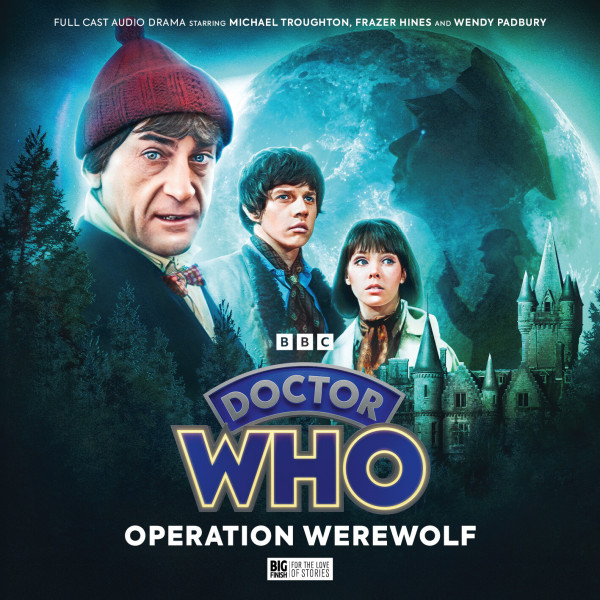
Operation Werewolf is a pretty decent Doctor Who audio drama from Big Finish Productions, but the story does feel a little longer than needed. This is an addition to The Lost Stories and would have featured the late Patrick Troughton as the Second Doctor if it was produced as considered during that era of the television series. His son, Michael Troughton, continues to fill in for his father alongside Frazer Hines and Wendy Padbury as Jamie McCrimmon and Zoe Herriot, respectfully. The script was written by Robert Kitts, who adapted the story idea from Douglas Camfield. David O’Mahoney serves as director of this play. The guest cast is pretty lengthy and includes Timothy Blore, Al Coppola, Stephanie Cornicard, and David O’Mahoney himself.
The Doctor, Jame, and Zoe arrive in Normandy just a few days before D-Day and soon find that the Germans are conducting experiments involving teleportation and brainwashing. I will go ahead and provide a spoiler in that there are no actual werewolves. Anyway, the Doctor gets separated from his companions and the TARDIS as usual. He once again has to protect the flow of history and avoid being a casualty of the Second World War.
The episode isn’t terrible, but I am having a hard time drumming up some real enthusiasm for it. It could be that the Doctor seems to spend a little too much time visiting the era of World War II, which feels annoyingly repetitive for a character who can travel anywhere in time and space.
As for the performances, everyone did fine. Michael Troughton does a pretty good version of his father’s role, but I still prefer Hines’ interpretation. I have quite an affection for this version of the Doctor, and it’s great that Michael has a regular gig to pay homage to his father.
Hines and Padbury still have that chemistry that have been charming and delighting audiences since the 1960’s. They obviously sound a little older, but it’s not too distracting. Hines can still pull off a convincing enough Scottish accent.
The writing is still pretty solid, but I just felt that six episodes not really justifiable for this particular story. Also, I think it would have been more interesting if werewolves were actually featured.
Operation Werewolf does have some elements that work pretty well, but it ultimately isn’t one I would consider all that special. I will say that more Second Doctor stories are still very welcome by this listener, and Michael Troughton can keep the gig as well.