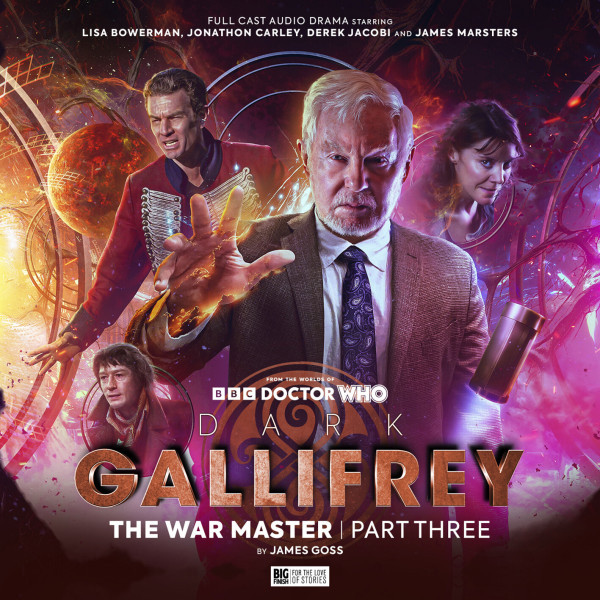
Dark Gallifrey: The War Master Part Two is an audio drama released by Big Finish Productions and continues this intriguing range that is a spin-off from Doctor Who. Scott Handcock directs this piece written by James Goss. Lisa Bowerman is back as Professor Bernice Summerfield and has to contend with the attentions from both Derek Jacobi’s version of the Master and James Marsters reprising his Torchwood role of Time Agent Captain John Hart.
Jason Forbes, Chris Lew Kum Hoi, and Tariye Peterside round out the cast.
Back to lecturing at Braxiatel University, Professor Bernice Summerfield has befriended the new Provost and has started a relationship with a student named John. John has started showing an interest in something the professor had once found, and he wants her help to get him to Dark Gallifrey. The Provost is also not who he claims to be and is indeed one of the Doctor’s most persistent enemies. Captain John Hart and the Master go from rivals to reluctant allies to get Bernice to once again seek out the secrets of Dark Gallifrey. Bernice may also have her own agenda and may be able to spring a trap of her own.
The story is a bit hard to follow sometimes, but it still works. Jacobi is just too fun in his performance for me to mind a bit of confusion. Marsters is also pretty amusing. There is a bit of a comedic and compelling fight scene between the Master and Captain John that is quite amusing.
Jacobi does give a delicious performance as the Master before he fled the Time War and hid so well that he had forgotten his own identity. He indulges himself with another clever disguise.
The chemistry between the lead trio is quite engaging and at times quite comical.
The Master did not really appear in the previous episode; however, the familiar charm and ruthlessness are in full supply in this one.
The other cast members are solid enough, but Derek Jacobi in particular is quite hard to keep with. Also, Lisa Bowerman also gives a masterclass in audio performance.
The sound design is expertly executed as well, thanks to Rob Harvey.
One more episode before this phase of the Dark Gallifrey closes out, and another one kicks off.
Doctor Who: The Third Doctor Adventures: Operation Vengeance is a new audio drama released by Big Finish Productions and stars Tim Treloar, stepping into the shoes of the late Jon Pertwee as the Doctor. Treloar also has the distinction of co-writing the script with Nicholas Briggs, who is also directing this piece.
Jon Culshaw returns as Brigadier Lethbridge-Stewart, who was originally played by the late Nicholas Courtney. Sadie Miller reprises the role her mother originally portrayed in the television series, Sarah Jane Smith. Katy Manning returns to her role as Jo Grant. Gareth Armstrong, Hannah Blaikie, Max Bowden, and Bronte Alice-Tadman are included in the rather lengthy guest cast.
The Doctor has been to the planet Konzomia, previously accompanied by Jo Grant. An old enemy thought dead has revealed himself to be among the living and has a wicked plan of vengeance to execute. The Doctor has Sarah Jane Smith at his side and determines that he has to return to Earth during the period where the Second World War was being fought. He is able to stop and collect his stalwart and courageous friend, Brigadier Lethbridge-Stewart in order to find Jo Grant’s father, who is in the midst of battle. The brilliant but maniacal scientist known as Raelchun is also displaced from his time and home planet and has his own plan to erase Jo from existence by killing Private Terry Grant. The Doctor, Sarah, and the Brigadier are determined to protect one of the Time Lord’s most cherished companions in the midst of one of the most terrible conflicts in Earth’s history.
There is quite a bit going on that keeps this from being a generally unpleasant listening experience, however I doubt I am going to count this among my favorites. In spite of how exciting the plot sounds, it seems to drag at times. Gareth Armstrong’s performance as Raelchun is pretty good, but he seems kind of a cliche Doctor Who villain at times.
Treloar’s efforts to emulate Jon Pertwee are quite effective. It’s not quite so hard to imagine that Pertwee himself is delivering the lines. Also, Sadie Miller is really sounding more and more like her late mother, Elisabeth Sladen.
Sometimes, the action was not that clearly depicted in the soundscape, but that’s bound to happen in an audio play.
There are some moments that are compelling, such as when we learn a bit more about the Brigadier’s past.
Although there some merits to this release, I still had some trouble staying with it all the way through.
I do applaud Treloar’s efforts to stretch himself as a writer, but it was a good thing that Briggs was there as his writing partner.
Even though I have a few criticisms of this episode, it still had some interesting ideas and themes. The chemistry between the main characters was still evident and made this more than bearable. The irony here is that very few of the characters are played by the original actors.
Anyway, it’s not the greatest thing that Big Finish has produced, but it’s still not necessary to pass it by completely. There is some still enjoyment that is not hard to find.
Doctor Who: The Seventh Doctor Adventures: Wicked! is an audio boxset which takes the audience back to when Ace first joined the Doctor in the TARDIS in this trilogy of episodes. Sylvester McCoy and Sophie Aldred once again prove themselves to be more than capable of replicating the enthusiasm they displayed when they started out on the television series almost four decades ago.
The guest cast in this set is comprised of Luke Barton, Tom Alexander, Alexandra Barredo, Simon Callow, Sophie Kennedy Clark, Ekow Quartey, and Paulo Vieira. Samuel Clemens returns to the director’s seat for all three episodes. I was not sure about the notion of going all the way back to the beginning of Ace’s travels in the TARDIS, but the set is overall quite good.
Alison Winter kicks off the set with Backwards and in Heels, which takes place in 1920s Soho. Ace and the Doctor are swept up into a [peculiar treasure hunt, and an alien presence has the young companion questioning her decision to accompany the Time Lord.
This story was a decent one if not the most memorable. I like the setting, and Ace being kind of impressed with a 1020s flapper. The friendship between the two lead characters starts to solidify as Ace gets a taste of what like traveling with the Doctor could entail.
Katharine Armitage follows up with The Price of Snow which takes place in the futuristic ski resort where some guests have disappeared, and the authentic snow seems to have some suspicious origins. There is also an unfortunate rift between a daughter and father.
This story is a bit better than the previous one. The alien menace at the heart of this one is new and not that badly realized. Tom Alexander is pretty compelling as the owner of the resort and the architect of the dangers as he uses some pretty ruthless calculations to keep his alien guests fed.
Finally, it is Alan Ronald who brings this set to a close with The Ingenious Gentlemen as Simon Callow delivers a hugely campy yet powerful performance as Don Quixote. In this case, the windmills may be something that is needed to be fought. Ace begins to notice some strange parallels between the partnership of Don Quixote and Sancho and her association with the Doctor.
Callow is absolutely magnificent, and the Doctor’s childlike joy at meeting him is perfectly performed by McCoy.
Obviously, this is the episode I consider to be the best in this collection.
I have to say that Sophie Aldred being able to pull off her younger voice when she is now in her sixties is quite impressive. I know that Aldred is a well-practiced voice artist, and I shouldn’t be that surprised, but her precision is still something to appreciate.
McCoy has also not missed a step here, and he is much older.
The idea of returning to Ace’s early travels seems like it should have been done earlier, but Big Finish continues to develop their stories and characters quite masterfully.
Doctor Who: The Thirteenth Doctor Adventures: The Return of the Doctor is an audio drama from Big Finish Productions with a rather humdrum sort of title, but the episode is actually better than it would appear. Jodie Whittaker and Mandip Gill return to the mics as the Doctor and Yasmin Khan in a story written by Rory Thomas-Howells and directed by Bethany Weimers.
The guest cast is comprised of Stephan Bessant, Charlie Kelly, Will Kirk, and Belinda Stewart-Wilson.
The Doctor and Yaz have just stopped an alien invasion menacing the Zaarians, who apparently resemble armadillos or something. Anyway, a young Zaarian is injured but is expected to recover, so the Doctor does what she always does and takes off. Yaz talks her into returning to help with the recovery, however the TARDIS takes them ten years into the future, and another more insidious alien presence is feeding on their guilt and sowing deep suspicion. It all starts with a whisper.
Jodie Whittaker’s turn as the Doctor on television really isn’t my favorite era of the program. This episode, in spite of the dubious title, is actually pretty good. Gill and Whittaker do have a pretty compelling chemistry which is performed quite well. My issues with Whittaker’s time on the television series had more to do with the writing and production choices than her as an actress.
Also, a new race and new adversary is introduced, and they are well written and realized.
I have said for years that Big Finish Productions successfully rehabbed the Sixth Doctor, who suffered low popularity ratings among the fans until he was able to showcase his talent with the aid of much better writing. It’s possible that Whittaker can enjoy the same experience.
Anyway, this episode was quite nicely done, and I may finally be able to appreciate the Thirteenth Doctor a bit more.
Doctor Who: The Ninth DoctorAdventures: Star-Crossed is an audio boxset that brings River Song in close quarters with the Ninth Doctor, played by Christopher Eccleston, in a satisfying trilogy of clever stories by three very reliable writers for Big Finish Productions. Alex Kingston returns to the microphone as the mysterious and often mischievous Professor River Song, and as much in love with the Doctor as ever. Helen Goldwyn gets to return to the director’s chair for this one.
The first story is written by John Dorney and is entitled Swipe Right. As the title would suggest, it concerns a dating app that has gone very wrong. The guest cast is comprised of David Holt, Tom Neenan, Beth Chalmers, and Francesca Mills.
The Doctor and River Song are each separately investigating disappearances on the planet Crell. They discover a being known as the Matchmaker. The Doctor and River Song are already married, but not just yet from the Time Lord’s perspective. As expected, the fireworks are about to light up the stars.
Dorney once again delivers an interesting story that sort of reflects something that could be going on in today’s society. Of course, no one is being forced into online dating in the real world, but there are likely going to be some interesting problems with AI.
When the Doctor and River finally meet up, it’s about as amusing and volatile as hoped. Eccleston and Kingston hit all the right notes in their performance. The script has also plenty of Doctor Who‘s expected humor.
This first entry is a solid kickoff to the set.
Lizzy Hopley follows up quite ably with Face of the Apocalypse. Charlie Tighe, Paul Reynolds, and Nadia Albina join the audio antics with Eccleston and Kingston as the guest cast.
The plot here concerns River Song’s face is being used to bring about total destruction of space and time through a complex computer algorithm. The Doctor has to unravel the problem with the help of a legendary pair of star-crossed lovers. He and River Song meet a couple whose union could be even more fraught with discord than their own. In order to save the universe, the Doctor and River will have to engage in a bit of couples’ therapy.
This story took me a little more patience to feel fully engaged. It does get better, and my appreciation for Hopley’s contribution grew due to the continued chemistry between the two leads. There are some pretty good one-liners, especially when River Song needles the Doctor about her face being the key to the universe’s survival.
It is once again down to the talent and enthusiasm exhibited by Eccleston and Kingston when performing this episode.
Finally, the set concludes with Tim Foley’s Archipelago. John Banks and Trevor Cooper are the guest actors.
The Doctor and River Song aid a captain who is taking a dangerous voyage to find his lost partner. His ship is going through a field of massive time distortion, and the last of the Time Lords may be the last chance for this boat to make it through.
The Doctor and River finally find the adventure in which they will get to know each other deeper than River could ever hope. The Doctor also gets spoilers as to his future and understands more of the connection between himself and River.
This story is a little hard to picture in my own mind, but I loved the performances. River Song is playing a dangerous game with being in the Doctor’s past. There are some amazing callbacks to the television series.
The solution is neatly imagined, and the continuity of the series remains intact.
River Song is usually an exciting foil for the Doctor in any of his incarnations. Her encounter with the Ninth Doctor was better than I thought it would be.
It’s a great set overall. I think the last story is my favorite out of this collection. So, the Doctor travels on….and so does River Song.
Doctor Who: The First Doctor Unbound: Knights of the Round TARDIS is an audio drama that kicks off a new range for Bog Finish Productions. David Bradley returns to his version of the First Doctor alongside Claudia Grant, Jamie Glover, and Jemma Powell returning to their versions of original TARDIS companion, Susan, Ian, and Barbara.
The script was written by LR Hay, and the director is David O’Mahoney. The guest cast is comprised of Matthew McQuinn, Robert Gill, Ewan Goddard, Adam Howden, Sophie Matthew, Joseph Millson, and Keith Wickham.
The TARDIS has taken its occupants to thirteenth century Oxford where they encounter a figure known as a precursor to English democracy, Simon de Montford. Friar Roger Bacon is also there; however, he seems to have another identity that knows the Doctor very well. The Monk is back in a new guise, but the Doctor has not encountered him before from his perspective. History is about to be radically changed unless the Doctor intervenes.
Bradley does a decent job in his presentation of the First Doctor, yet he seems to be able do it without relying on an impersonation of the late William Hartnell. Bradley, of course, played Hartnell some years ago in a special docudrama about the origin of Doctor Who.
The idea is to have a series that isn’t quite so hung up on the continuity within the television series, although I am not really sure how successful the writers and producers are in actually accomplishing that.
I am not that familiar with the historical context this series was supposed to convey, but I still enjoyed it. I may have to research some of the figures like de Montfort and Roger Bacon to understand their significance to British history to better appreciate this story.
Bradley is considered something of a legend in British drama, or at least he works pretty consistently for a guy his age, which is eighty-three. Anyway, I love his portrayal of the First Doctor.
Wickham also seems to be a solid casting choice for Bacon, who turns out to be the renegade Time Lord known as the Monk. Apparently, he was inspired to emulate the style of the original actor, the late Peter Butterworth, who appeared in the original television serial entitled The Time Meddler alongside Hartnell.
It’s fun to revisit the First Doctor era in its many iterations presented by Big Finish, and this episode is a promising new direction.
Sightseeing in Space is a volume containing two mediocre Doctor Who novellas written by David Bailey and Steve Lyons.
To be fair, I think the target audience for this release is significantly younger than me, but I couldn’t help still being a bit disappointed.
The first story is entitled Terminal of Despair written by the usually reliable Steve Lyons. He has been writing Doctor Who fiction for many years for several ranges in print.
The Doctor and his companions, Amy and Rory, arrive on a spaceport in which would-be passengers have been quarantined for several months by strange creatures which feed on hope. These creatures resemble three-legged bulldogs that have some tentacle that protrude from their mouths to latch on a victim’s neck and drains any sense of hope from them.
The alien species dubbed Desponds is new, but I had some trouble visualizing these things. Also, there was no real clear opponent in charge of this chaos. Lyons does a decent job of capturing the Eleventh Doctor’s mannerisms for the most part.
I had some trouble maintaining any real interest in the side characters. Also, no one died, which I guess is an indicator that the youth were the intended audience.
I remember looking forward to a Lyons novel and usually appreciating his imagination, so I had high hopes for his contribution here. Sadly, my hopes were unrealized. The story was not terrible, but there was not much of an impression left.
The second story, David Bailey’s The Web in Space, is a slightly better. The Doctor, Amy, and Rory become trapped in a spaceship which is being attacked by scavengers. It also becomes trapped in a giant web in space where a massive spider awaits to feed. A maniacal robot has its eyes set on access to the TARDIS. The Doctor has a lot of threats to resolve before he and his friends can be on their way.
I enjoyed this story more, but there are still better contributions to Doctor Who literature. Bailey is a competent writer, but there is nothing that really stands out about his writing style.
At least it was some Doctor Who I had not read before. The volume is another that is not a complete waste of time, but it does not leave much of a lasting impression.
Next up, I am revisiting a reliable and favorite thriller writer of mine. Alex Delaware and Milo Sturgis being investigating a curious double murder at a poolside in Jonathan Kellerman’s The GhostOrchid.
Alixion is a Doctor Who audio play from Big Finish Productions and is the latest addition to The Lost Stories range. The addition has its good points, especially with Sylvester McCoy and Sophie Aldred leading the cast as the Doctor and Ace, respectively, however it’s a bit of a confusing mess as far as the story goes at times.
This story was originally intended to be produced during the television era in the 1980’s, however that is when the series got cancelled. Robin Mukherjee wrote the script and was able to adapt it to the audio format. David O’Mahoney serves as the director. Ali Bastian, Jon Edgley Bond, Matthew McQuinn, Beverly Longhurst, and Shri Patel make up the guest cast. Even O’Mahoney himself lends his own vocal talents to the effort.
Another planned holiday for the Doctor and Ace goes awry when they arrive at a luxury resort that has been compromised by an entity that feeds off memories and regrets. The Time Lord and his young friend have to face their own darkest secrets and fears as well as a malevolent alien who can inflict the most diabolical of mental tortures.
The plot itself sounds pretty intriguing; however, I think this would have worked better on television since there is quite a bit of flashbacks.
McCoy and Aldred are too good themselves to make me regret listening to this, so I may just need to return to this one to get a better grasp of the events that I can only picture in the mind’s eye.
The Seventh Doctor can be considered one of the more complicated incarnations depicted, and this story does play with that, which still keeps things intriguing.
I know I called this episode a confusing mess at the top of this post, but that doesn’t mean that I disliked it overall. Sometimes, the joy of listening the performances of pretty much any of the Doctors and their companions does carry manage to carry me to some significant enjoyment, and this experience was no exception.
I have found that listening to the cast and crew interviews most of these releases now contain does help my comprehension of the story quite a bit.
In spite of my occasional perplexion of some elements of the plot, I still found quite a bit to appreciate about this release and hope that McCoy and Aldred have a lot more gas in the tank to perform new stories to represent their era of the series.
Doctor Who: Past Forward is a Doctor Who audio set from Big Finish Productions which sees the welcome return of Sylvester McCoy as the Seventh Doctor as the arc featuring with Harry Sullivan and Naomi Cross seemingly comes to an end. The structure of these stories is a little different in that there is essentially four-part story with a separate two-part adventure wedged in between, and it does work rather nicely.
Eleanor Crooks is back as Naomi Cross while Christopher Naylor resumes his impressive efforts to emulate the late Ian Marter as Harry Sullivan. Sara Griffiths joins the fray as Ray Jenkins, who was introduced in the television serial entitled Delta and the Bannermen. The guest cast of this series is comprised of Laura Aikman, Lydia Baksh, Daon Broni, Cavin Cornwall, Josh Cowdery, Alasdair Hankinson, Katherine Jack, Holly Jackson Walters, and Gary Turner.
The directing duties falls yet again to Samuel Clemens, who as usual keeps a steady hand by probably just letting the actors get on with the job.
Doctor Who veteran writer John Dorney is the writer of With the Angels, which has the Doctor encounter the Weeping Angels, which were first popularized in the television revival during the David Tennant era. It still works to have earlier Doctors meet these strange, malevolent consumers of time energy.
This time, the Angels have been fashioned into chess pieces. The Doctor, Harry, and Naomi will be pulled into both the past and future as they are recruited once again by UNIT to save Earth from another invasion by the terrifying Angels that one cannot take their eyes off.
In the second half of the story, the Doctor has been able to say goodbye to Harry and Naomi and pick up a new companion in the shape of an old friend, Ray. It’s kind of a unique transition, but it is done quite cleverly. Ray probably would have been a fun companion in the television series if things had worked out differently back then, but audiences now get to see how that would have worked. The also intriguing choice that was made was to have Ray picked up twenty years after her first encounter with the Doctor and she has lived a life of her own. Ray was probably in her late teens or early twenties when she was introduced over three decades ago, but it seems a good choice for Dorney to have seasoned that character a bit while still making her recognizable.
Sandwiched between the middle of With the Angels, is Lizzie Hopley’s Catastrophix where acompany’s experiment with Time if bringing about the Earth’s early demise. The Doctor has promises to Harry and Naomi to keep and ensure their safety after their encounter with the Angels. Also, this is where Ray gets a proper reintroduction.
The story itself is pretty good. Hopley is becoming one of the reliably interesting writers for Big Finish.
As usual, McCoy’s performance is outstanding even though he does have to do a bit of a double act when it becomes clear that he is being manipulated by a very familiar presence.
The team of Cross and Sullivan will be missed aboard the TARDIS, but the addition of Ray seems to be the start that could be equally compelling.
The exaggerated American accents by some of the guest cast was a little distracting, but I have gotten kind of used to it over the years of listening to Big Finish.
Anyway, the whole chess trope for this Doctor worked, although it’s hard to picture what was going on during the climactic match between the Time Lord and rich snob who instigated the whole catastrophe with the Angels.
This set was one of the better ones to be released this year from Big Finish, and McCoy’s enthusiastic performance is still a welcome distraction from the pressures of everyday life.
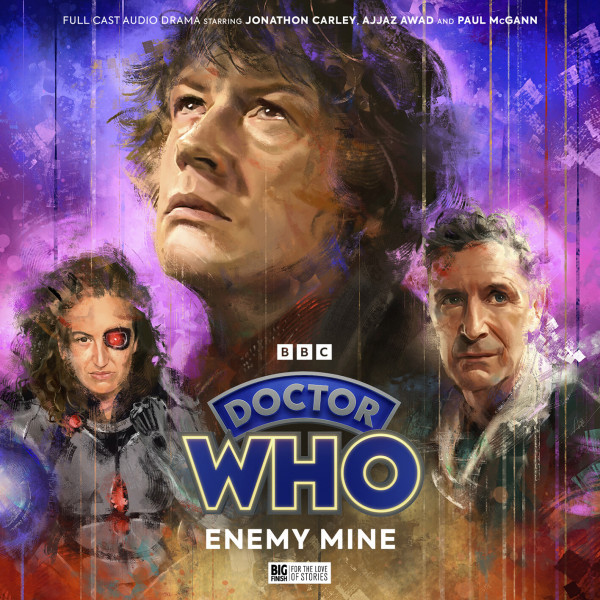
Doctor Who: The War Doctor Begins: Comrades-In-Arms is another compelling collection of episodes presented by Big Finish Productions in which Jonathon Carley channels the performance of the late John Hurt as the Time Lords once known as the Doctor. Ajjaz Awad returns as the cyborg known as Case, a new piece on the board as the Time War continues to rage between Gallifrey and the Daleks.
Barnaby Kay serves as director for the three stories that are each worthy of appreciation for a variety of reasons. Most of all the War Doctor, who I sort of had a derision reaction to when he was first introduced in the fiftieth anniversary special The Day of the Doctor, has become more fascinating under the auspice of Big Finish Productions.
Of course, Nicholas Briggs fires up his voice modulator to voice the Daleks. The guest cast for this collection is comprised of Michael Amariah, Tiegan Byrne, Beth Chalmers, Esmonde Cole, Sophie Khan Levy, Georgia Mackenzie, Deeivya Meir, and Lynsey Murrell.
The first episode to discuss is entitled A Mother’s Love by Noga Flaishon. The War Doctor, played by Jonathon Carley, has arrived on a Time Lord field hospital known as Haven. It is operated by an Artificial Intelligence known Medbay Operation Mainframe or MOM. The War Doctor also has another encounter with an old ally known as Case, who was partially converted to a Dalek but was able to override the programming. A new but dangerous friendship is developing between her and the War Doctor, but they may not have time to explore that before MOM and the Daleks interfere.
This first story is pretty good. The idea of Case willing to enter into the Time War on her own terms. Carley’s impression of John Hurt’s voice has done nothing but improve. Also, the difference between this incarnation and the other Doctors is slowly coming to light. The War Doctor desperately wants to show the compassion displayed by his other selves, but he is a warrior now. Also, Case has become a fascinating conundrum herself. If there isn’t enough of a reason to be suspicious of AI, this story just adds fuel to that particular fire.
Berserker by Timothy X. Atack brings the War Doctor and Case to face the most dangerous of Daleks. One that has gone made from the centuries of isolation and not being able to kill anyone or anything. In an underground bunker, the War Doctor and his new companion have to face an insane threat that is a ruthless killer at the best of times and each other as it becomes apparent how the War Doctor can use his companion as a devastating weapon against the Daleks.
Briggs puts in a deliciously terrifying performance here. He is the expert over the years he has portrayed the Daleks, and he achieves a new level of insanity with this piece. The more mercenary tendencies of the War Doctor also become more evident, although the more familiar traits are not entirely gone. The War Doctor does genuinely care for Case and still wants her to make her own choices on how she wants to fight in the Time War. The conflict and suspicion displayed is well written, and Carley knows how to hit those right notes of sorrow and determination that John Hurt could exude so well when he first played the part.
The middle story has plenty of merit here.
Finally, this trilogy comes to a close with Phil Mulryne’s Memnos. The War Doctor and Case have arrived at a secret base where a project known as Memnos has been launched. The idea is to preserve the memory of planets and civilizations devastated by the Daleks. Case also has a chance to find her origins before she was so corrupted by the Daleks. The Dalek Time Strategist also is on their trail and has his own plans for Case.
There are some heart wrenching moments between Case and the War Doctor as she becomes more uncertain as to his loyalty and motives for trying to help her. The Time Strategist also emerges as a most dangerous and despicable foe.
This is another fascinating entry into the range. It also is a strong finish to the set. The lead actors are excellent in all three stories. It is surprising that this is becoming a favorite range for me.
Also, it is slowing becoming clearer as to why the War Doctor made the decision to end the Time War with the destruction of both sides, which haunted him when the new television series was aired in 2005.
In spite of this bold direction in the franchise, it is reassuring that many other elements of the Doctor’s nature shine through at times. There are even some familiar moments of humor even in the midst of such a dark backdrop.
As usual, the sound engineering is stellar. There is little to criticize here. Some of the action sequences are hard to imagine occasionally, but there is plenty to still enjoy and at times marvel as these episodes blare from the speakers.
If one has to be in a Time War, the War Doctor would be the one to have in their corner. Although it is sad that John Hurt is no longer with us, Jonathon Carley is more than capable of honoring him with his participation in this series.